
Kia Stinger CK: Engine Control System / Rail Pressure Sensor (RPS)
Specifications
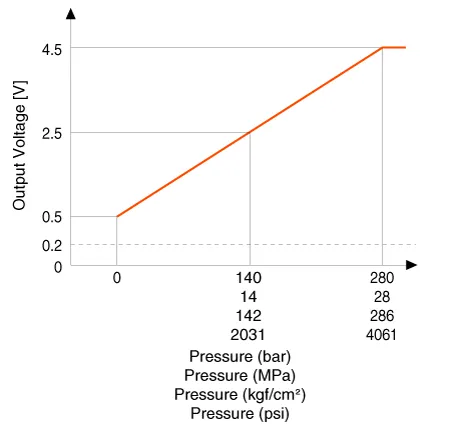
| Specification |
|
Pressure |
Output Voltage (V) [Vref=5V] |
|
|
bar |
[MPa (kgf/cm², psi)] |
|
|
0 |
0 (0, 0) |
0.5 |
|
140 |
14 (142, 2031) |
2.5 |
|
280 |
28 (286, 4061) |
4.5 |
Description and operation
| Description |
Installed on the delivery pipe, the Rail Pressure Sensor (RPS) measures the instantaneous fuel pressure in the delivery pipe. The sensing element (semiconductor element) built into the sensor converts the pressure to voltage signal. By using this signal, the ECM controls the correct injection amount and timing and adjusts the fuel pressure with the fuel pressure regulator valve if the actual pressure calculated by the RPS output signal is different from the target pressure.

Schematic diagrams
| Circuit Diagram |

| Harness Connector |

Repair procedures
| Inspection |
| 1. |
Connect the KDS on the Data Link Connector (DLC). |
| 2. |
Measure the output voltage and fuel pressure of the RPS at idle and various engine speed.
|
||||||||||||||

| Removal |
| 1. |
Release the residual pressure in fuel line. (Refer to the Fuel Delivery System - "Release Residual Pressure in Fuel Line") |
| 2. |
Switch "OFF" the ignition and disconnect the negative (-) battery terminal. |
| 3. |
Remove the intake manifold. (Refer to Engine Mechanical System - “Intake Manifold”) |
| 4. |
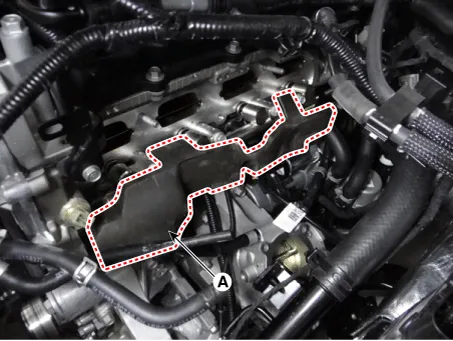
Remove the delivery pipe foam (A).
|
| 5. |
Disconnect the rail pressure sensor connector (A), and then remove the sensor (B) from the delivery pipe.
|

| Installation |
|

| 1. |
Install in the reverse order of removal. |
Troubleshooting
| Signal Waveform |


Other information:
Kia Stinger (CK) 2018-2023 Service Manual: If the engine overheats
If your temperature gauge indicates overheating, you experience a loss of power, or hear loud pinging or knocking, the engine will probably be too hot. If this happens, you should: 1.Pull off the road and stop as soon as it is safe to do so. 2.Place the shift lever in P and set the parking brake. If the air conditioning is on, turn it off. 3.Components and components location Components 1. Radiator 2. Radiator upper hose 3. Radiator lower hose 4. Radiator upper mounting bracket (RH) 5. Radiator upper mounting bracket (LH) 6. Radiator lower mounting insulator (RH) 7. Radiator lower mounting insulator (LH) 8. Cooling fan assembly 9.Categories
- Manuals Home
- Kia Stinger Owners Manual
- Kia Stinger Service Manual
- New on site
- Most important about car
