
Kia Stinger CK: Engine Control System / Exhaust Gas Temperature Sensor (EGTS)
Specifications
| Specification |
Exhaust Gas Temperature Sensor (EGTS) #1, 2
▷ Type : Thermistor type
|
Temperature [°C (°F)] |
Resistance (kΩ) |
|
-40 (-40) |
0.17 |
|
0 (-32) |
0.201 |
|
100 (212) |
0.276 |
|
200 (392) |
0.35 |
|
300 (572) |
0.42 |
|
400 (752) |
0.489 |
|
500 (932) |
0.555 |
|
600 (1112) |
0.618 |
|
700 (1292) |
0.68 |
|
800 (1472) |
0.739 |
|
850 (1562) |
0.767 |
Description and operation
| Description |
Installed in exhaust manifold, the Exhaust Gas Temperature Sensor (EGTS) #1 for WGT senses the temperature of exhaust gas flowing into the WGT.
Installed in Gasoline Particulate Filter (GPF) assembly, the Exhaust Gas Temperature Sensor (EGTS) #2 for GPF senses the temperature of exhaust gas flowing into the GPF.
When predetermined engine condition is met, ECM burns soot collected in GPF with exhaust gas. During this, the exhaust gas temperature is an important factor of engine condition.
Schematic diagrams
| Circuit Diagram |
EGTS #1
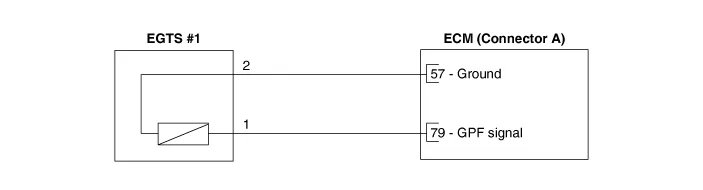
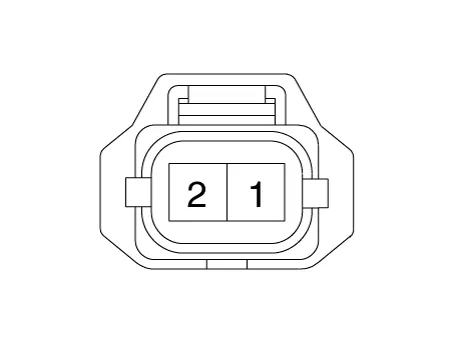
Harness Connector
EGTS #2
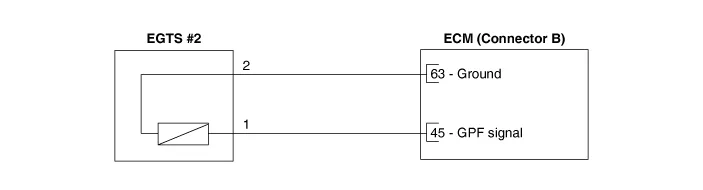
Harness Connector
EGTS #3
Repair procedures
| Inspection |
| 1. |
Turn ignition switch OFF. |
| 2. |
Disconnect the connector of exhaust gas temperature sensors #1/#2/#3. |
| 3. |
Measure resistance between sensor signal terminal and ground terminal. |
| 4. |
Check that the resistance is within the specification. Exhaust Gas Temperature Sensor [EGTS #1, #2, #3 (T3, T4, T5)]
|
| Removal & Installation |
[EGTS #1]
| 1. |
Turn the ignition switch OFF and disconnect the battery negative (-) terminal. |
| 2. |
Remove the floor under cover. |
| 3. |
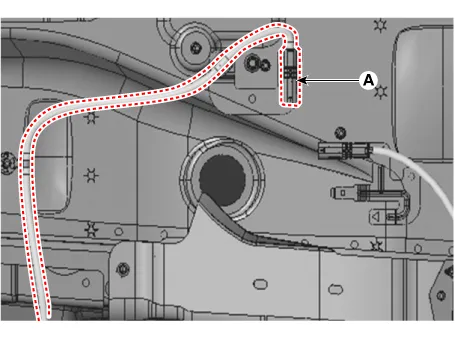
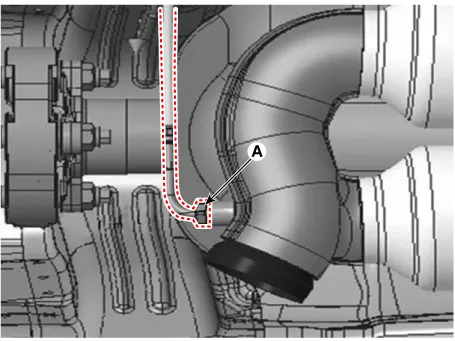
Disconnect the EGTS connector (A).
|
| 4. |
Remove the EGTS (A).
|
| 5. |
Install the sensor in the reverse order of removal.
|

[EGTS #2]
| 1. |
Turn the ignition switch OFF and disconnect the battery negative (-) terminal. |
| 2. |
Remove the floor under cover. |
| 3. |
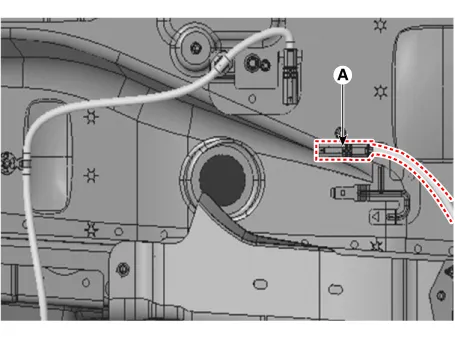
Disconnect the EGTS connector (A).
|
| 4. |
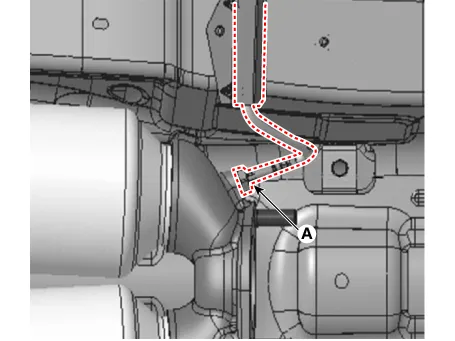
Remove the EGTS (A).
|
| 5. |
Install the sensor in the reverse order of removal.
|
[EGTS #3]
| 1. |
Turn the ignition switch OFF and disconnect the battery negative (-) terminal. |
| 2. |
Remove the floor under cover. |
| 3. |
Disconnect the EGTS connector (A).
|

| 4. |
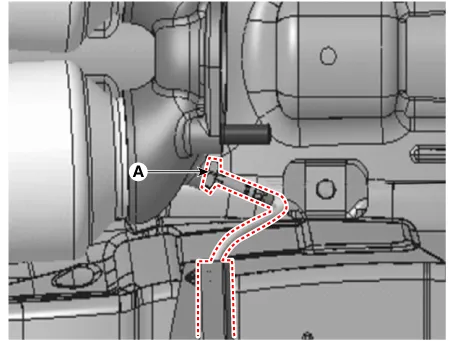
Remove the EGTS (A).
|
| 5. |
Install the sensor in the reverse order of removal.
|


Other information:
Kia Stinger (CK) 2018-2023 Service Manual: Wireless Power Charging (WPC) Unit
Components and positions Components Circuit diagram Circuit Diagram Repair procedures Removal • Handling wireless charging system parts by wet hands may cause electric shock. • Put on gloves to protect your hands.Kia Stinger (CK) 2018-2023 Service Manual: Active hood sensor & unit assembly
Repair procedures Replacement 1. Disconnect the negative battery terminal. After disconnecting the cables, wait at least 30 seconds. 2. Remove the front bumper assembly. (Refer to Body - "Front Bumper Assembly") 3.Categories
- Manuals Home
- Kia Stinger Owners Manual
- Kia Stinger Service Manual
- New on site
- Most important about car
