
Kia Stinger CK: Power Train / Spark Plug
Repair procedures
| Inspection |
| [On vehicle inspection] |
| 1. |
Accelerate the engine to about 3,000 rpm 3 times or more. |
| 2. |
Remove the spark plug. |
| 3. |
Check the spark plug visually. If the electrode is dry, the spark plug is normal. If the electrode is wet, check the damage and electrode gap as below. |
| [Component Inspection] |
| 1. |
Check the spark plug for any damage on its thread and insulator. If there is damage, replace the spark plug. |
| 2. |
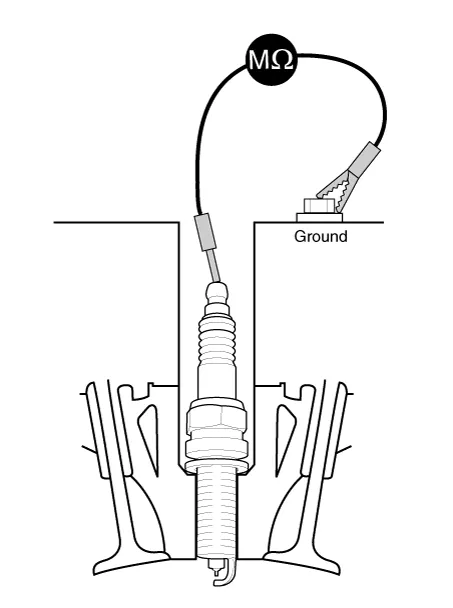
Check the electrode. Measure the insulation resistance with an ohmmeter. If the resistance is less than the specified value, adjust the electrode gap.
|
| 3. |
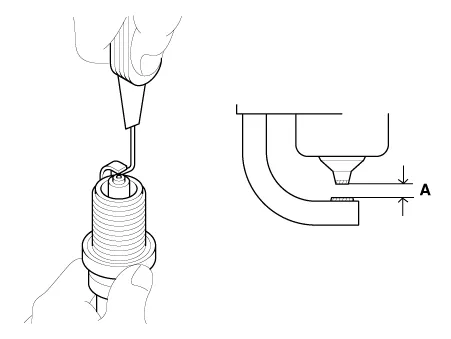
Check the spark plug electrode gap. If the gap is greater than the maximum, replace the spark plug.
|

| Removal |
| Theta-II 2.0 T-GDI |
| 1. |
Remove the ignition coil. (Refer to Ignition System - "Ignition Coil") |
| 2. |
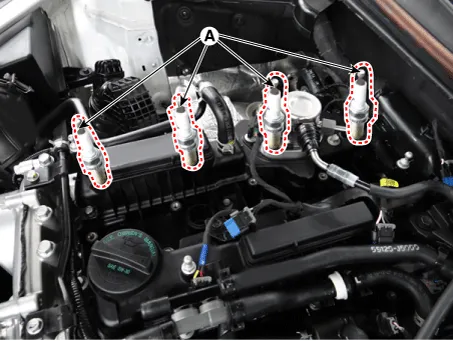
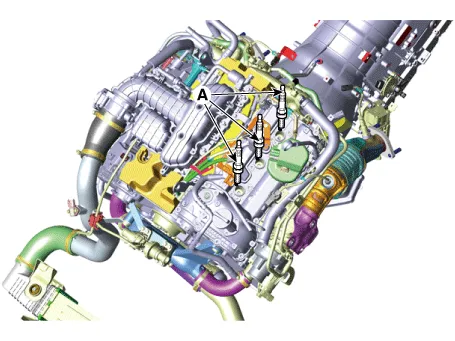
Using a spark plug wrench, remove the spark plug (A).
|
| Lambda-II 3.3 T-GDI |
| 1. |
Remove the ignition coil. (Refer to Engine Electrical System - "Ignition Coil") |
| 2. |
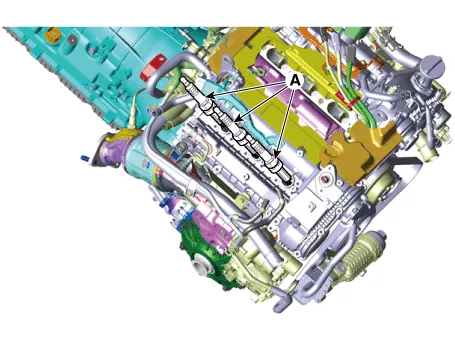
Using a spark plug wrench, remove the spark plug (A). [Bank 1]
[Bank 2]
|


Other information:
Kia Stinger (CK) 2018-2023 Service Manual: Cruise control system
The cruise control system allows you to program the vehicle to maintain a constant speed without depressing the accelerator pedal. This system is designed to function above approximately 30 km/h (20 mph ). If the cruise control is left on, (cruise indicator light is illuminated), the cruise control can be switched on accidentally. Keep the cruise control system off when the cruise control is not in use, to avoid inadvertently setting a speed.■ Front seat • Type A ■ Front seat • Type B ■ Rear seat The seat warmer is provided to warm the front seats during cold weather. With the ignition switch in the ON position, push up either of the switches to warm the driver's seat or the front passenger's seat. During mild weather or under conditions where the operation of the seat warmer is not needed, keep the switches in the “OFF” position.Categories
- Manuals Home
- Kia Stinger Owners Manual
- Kia Stinger Service Manual
- New on site
- Most important about car
