
Kia Stinger CK: Engine Control System / Heated Oxygen Sensor (HO2S)
Specifications
| Specification |
HO2S [Bank 1/Sensor 1]
|
Item |
Specification |
|
Heater Resistance (Ω) |
2.5 - 4.0 [20°C(68°F)] |
HO2S [Bank 1/Sensor 2]
|
Item |
Specification |
|
Heater Resistance (Ω) |
3.3 - 4.1 [20°C(69.8°F)] |
Description and operation
| Description |
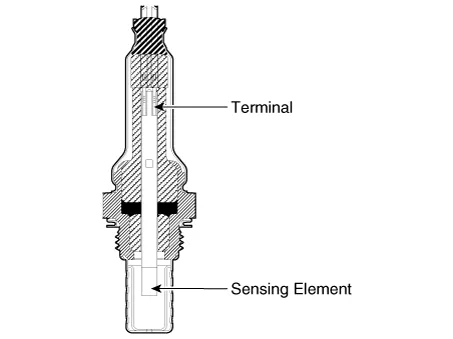
Heated Oxygen Sensor (HO2S), consisting of zirconium and alumina, is installed on both upstream and downstream of the Catalytic Converter to detect the air/fuel ratio and send it to the ECM.
The sensor must be heated in order to operate properly. To keep it heated, the sensor has a heater which is controlled by the ECM via a duty cycle signal. When the exhaust gas temperature is lower than the specified value, the heater warms up the sensor tip.
Schematic diagrams
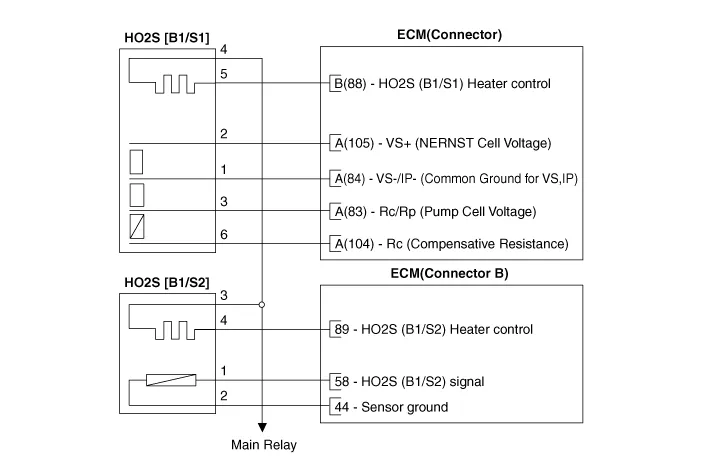
| Circuit Diagram |
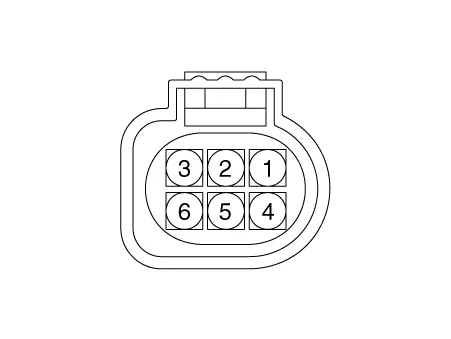
Harness Connector
[Bank 1 / Sensor 1]
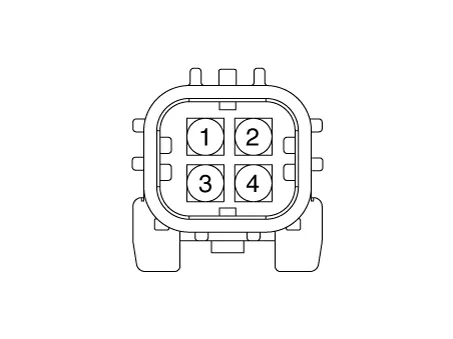
[Bank 1 / Sensor 2]
Repair procedures
| Inspection |
| 1. |
Switch "OFF" the ignition. |
| 2. |
Disconnect the HO2S connector. |
| 3. |
Measure resistance between the HO2S terminals 4 and 5 [B1/S1].
|
| 4. |
Measure resistance between the HO2S terminals 3 and 4 [B1/S2].
|
| 5. |
Check that the resistance is within the specification. |
| Removal |
Note that the SST (Part No. : 09392-1Y100 or 09392-2H100) is useful when removing the heated oxygen sensor. |

[Bank 1 / Sensor 1]
| 1. |
Switch "OFF" the ignition and disconnect the negative (-) battery terminal. |
| 2. |
Disconnect the connector (A), and then remove the sensor (B).
|
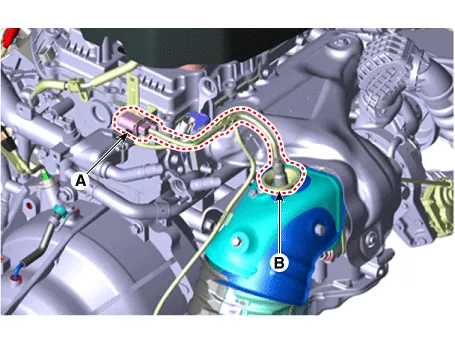
[Bank 1 / Sensor 2]
| 1. |
Switch "OFF" the ignition and disconnect the negative (-) battery terminal. |
| 2. |
Disconnect the connector (A).
|
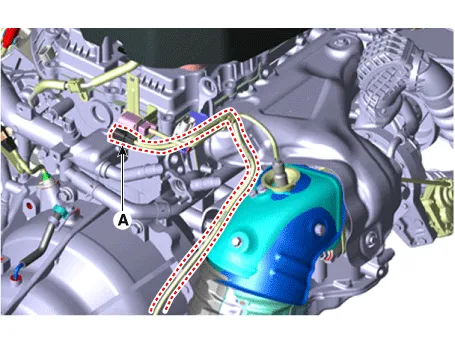
| 3. |
Lift the vehicle. |
| 4. |
Remove the catalytic converter bracket (A). |
| 5. |
Remove the sensor (B).
|
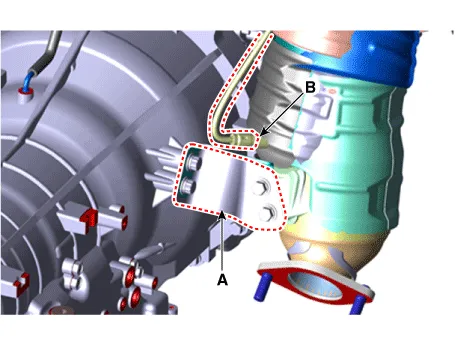
| Installation |
|
| 1. |
Install in the reverse order of removal.
|


Other information:
Kia Stinger (CK) 2018-2023 Service Manual: Parking Brake Assembly
Repair procedures Removal 1. Turn ignition switch OFF and disconnect the negative (-) battery cable. 2. Remove the crash pad lower panel. (Refer to Body - "Crash Pad Lower Panel") 3. Remove the knee airbag. (Refer to Restraint - "Knee airbag (KAB) module") 4.Repair procedures Front wheel alignment When using a commercially available computerized wheel alignment equipment to inspect the front wheel alignment, always position the vehicle on a level surface with the front wheels facing straight ahead. Prior to inspection, make sure that the front suspension and steering system are in normal operating condition and that the tires are inflated to the specified pressure.Categories
- Manuals Home
- Kia Stinger Owners Manual
- Kia Stinger Service Manual
- New on site
- Most important about car
