Kia Stinger CK: Engine Control System / RCV Control Solenoid Valve
Specifications
Item
|
Specification
|
Coil Resistance (Ω)
|
28.3 - 31.1 [20°C(68°F)]
|
Description and operation
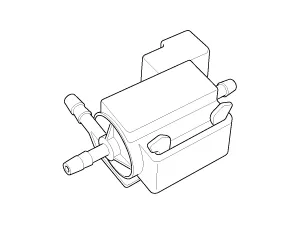
Installed on the intercooler inlet pipe, the RCV (Recirculation Valve) Control
Solenoid Valve operates the RCV actuator which controls the by-pass passage of the
turbocharger compressor. When the throttle is closed with the engine running at
cruise rpm (tip-out), the turbocharger boost pressure increases rapidly. The pressure
wave strikes a compressor blades causing a knocking noise. To prevent this, the
ECM opens the recirculation valve which allows excessive boost pressure to vent
back to the air cleaner side of the turbocharger compressor.
Schematic diagrams

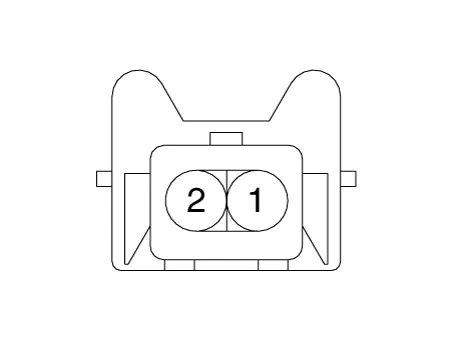
Harness Connector
Repair procedures
| 1. |
Switch "OFF" the ignition.
|
| 2. |
Disconnect the RCV control solenoid valve connector.
|
| 3. |
Measure resistance between the valve terminals 1 and 2.
|
| 4. |
Check that the resistance is within the specification.
|
Specification : 28.3 - 31.1 Ω [20°C(68°F)]
|
|
| 1. |
Switch "OFF" the ignition and disconnect the negative (-) battery terminal.
|
| 2. |
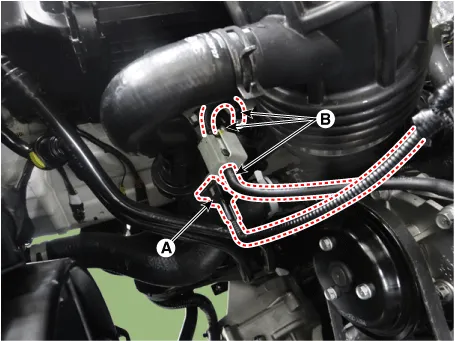
Remove the RCV control solenoid valve after disconnecting the connector
(A), RCV hoses (B).
|
| • |
Do not apply oil when hose is assembled.
|
| • |
The hose should be inserted perfectly to nipple.
|
|
| 1. |
Install in the reverse order of removal.
|
Other information:
Kia Stinger (CK) 2018-2023 Service Manual: Transmission ranges
The indicator in the instrument cluster displays the shift lever position when
the ignition switch is in the ON position.
P (Park)
Always come to a complete stop before shifting into P (Park). This position locks
the transmission and prevents the drive wheels from rotating.
Shifting into P (Park) while the vehicle is in motion will cause the drive wheels
to lock which will cause you to lose control of the vehicle.
Kia Stinger (CK) 2018-2023 Service Manual: Cooling System
Repair procedures
Inspection
Radiator hoses
1.
Check radiator hoses for the following
(1)
Improper attachment
(2)
Leaks
(3)
Cracks
(4)
Damage
(5)
Loose connections
(6)
Chafing
(7)
Deterioration
Coolant level
1.