
Kia Stinger CK: Automatic Transmission Control System / Transmission Oil Temperature Sensor
Specifications
| Specifications |
|
Item |
Specification |
|
|
Oil temperature sensor |
Type |
*NTC thermistor |
|
Temp.[(°C)°F] / Resistance (kΩ) |
(-40)-40 / 139.5 |
|
|
(-20)-4 / 47.4 |
||
|
(0)32 / 18.6 |
||
|
(20)68 / 8.1 |
||
|
(40)104 / 3.8 |
||
|
(60)140 / 1.98 |
||
|
(80)176 / 1.08 |
||
|
(100)212 / 0.63 |
||
|
(120)248 / 0.38 |
||
|
(140)284 / 0.25 |
||
|
(150)302 / 0.16 |
||
*NTC: Negative Temperature Coefficient
Components and components location
| Components |
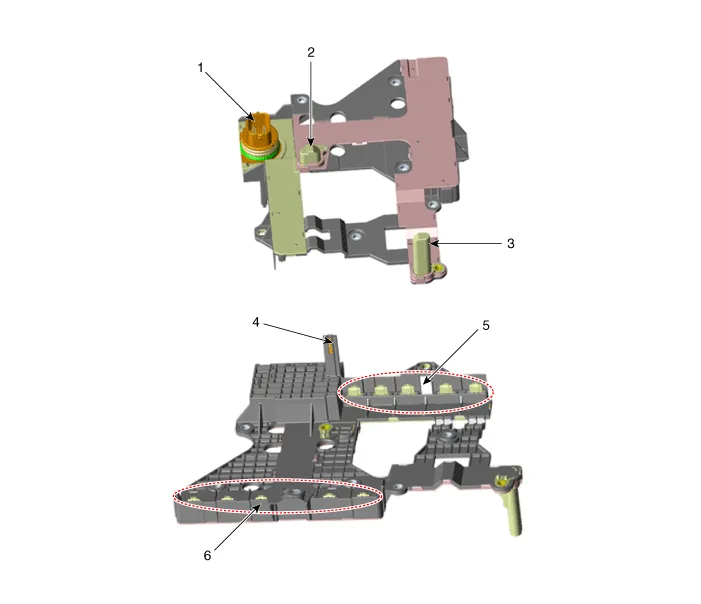
| 1. E module connector 2. Output speed sensor 3. Input speed sensor |
4. Oil temperature sensor 5. Indirect control solenoid valve connector 6. Direct control solenoid valve connector |
Description and operation
| Description |
| • |
The sensor used is a thermistor (NTC) in which resistance changes with temperature variation. |
| • |
When the TCM supplies power to sensor, the sensor output value changes depending on ATF temperature. |
| • |
Oil temperature sensor is integrated with E module. |
Schematic diagrams
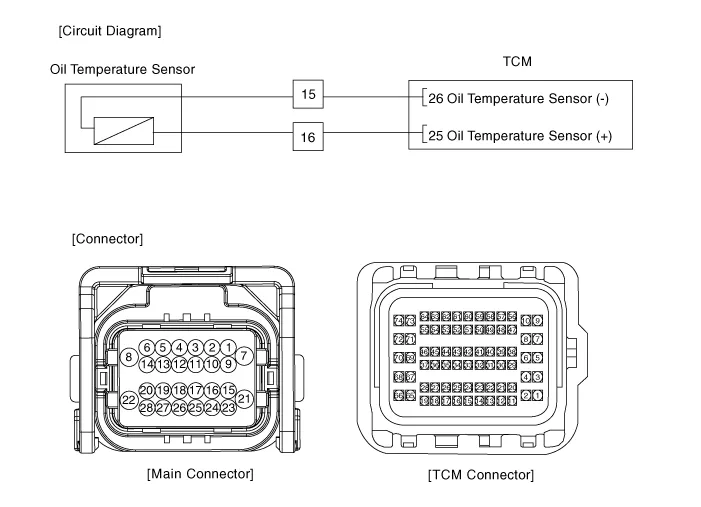
| Circuit Diagram |
Repair procedures
| Inspection |
| 1. |
Switch "OFF" ignition. |
| 2. |
Disconnect the main connector (A).
|

| 3. |
Measure the resistance between + terminal (15) and - terminal (16). |
| 4. |
Check that the resistance is within the specification.
|
||||||||||||||||||
| Replacement |
The oil temperature sensor is integrated into the E-module that can’t be disassembled. So refer to “E-module” for the removal or installation procedure of the oil temperature sensor. |

| 1. |
Replace the E-module. (Refer to Automatic Transmission Control System - "E-Module") |


Other information:
Kia Stinger (CK) 2018-2023 Service Manual: Rear Assist Arm
Repair procedures Removal 1. Remove wheel nuts, wheel and tire (A) from hub. Tightening torque: 107.9 - 127.5 N·m (11.0 - 13.0 kgf·m, 79.6 - 94.0 lb·ft) Be careful not to damage the wheel bolts when removing the wheel and tire (A).Kia Stinger (CK) 2018-2023 Service Manual: Front Door Outside Handle
Components and components location Component Location 1. Front door outside handle Repair procedures Replacement Put on gloves to protect your hands. • When prying with a flat-tip screwdriver or using a prying trim tool, wrap protective tap around the tool and related parts to prevent damage.Categories
- Manuals Home
- Kia Stinger Owners Manual
- Kia Stinger Service Manual
- New on site
- Most important about car
