
Kia Stinger CK: Features of your vehicle / Fuel filler lid
Contents:
Opening the fuel filler lid
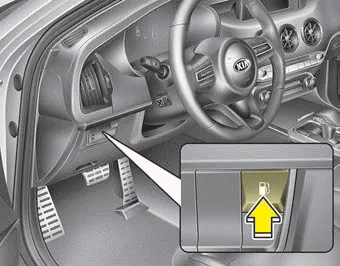
The fuel filler lid must be opened from inside the vehicle by pressing the fuel filler lid opener button.
If the fuel filler lid does not open because ice has formed around it, tap lightly or push on the lid to break the ice and release the lid. Do not pry on the lid. If necessary, spray around the lid with an approved de-icer fluid (do not use radiator anti-freeze) or move the vehicle to a warm place and allow the ice to melt.
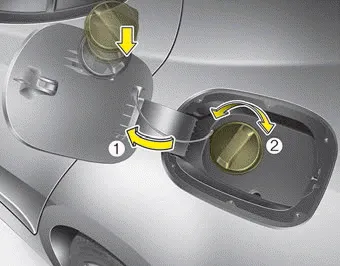
1. Stop the engine.
2. To open the fuel filler lid, push the fuel filler lid opener button.
3. Pull open the fuel filler lid (1).
4. To remove the cap, turn the fuel filler cap (2) counterclockwise.
5. Refuel as needed.
Closing the fuel filler lid
1. To install the cap, turn it clockwise until it “clicks” once. This indicates that the cap is securely tightened.
2. Close the fuel filler lid and push it in lightly making sure that it is securely closed.
✽ NOTICE
There may be an intermittent noise near the refueling hole while the engine is idling if the fuel cap is not closed securely. This occurs normally with the OBD system.
✽ NOTICE
When refueling on unlevel ground, the fuel gauge may not point to the F position.
It is not a malfunction. If you move your vehicle to a level ground, the fuel gauge will move to the full position.
Emergency fuel filler lid release ➤


Other information:
Kia Stinger (CK) 2018-2023 Owner's Manual: Specifications
Service data Service Data Purge Control Solenoid Valve (PCSV) ▷ Specification Item Specification Coil Resistance (Ω) 18.5 - 22.5 [20°C(68°F)] Tightening torque Tightening Torques Item kgf·m N·m lb·ft Positive crankcase ventilation valve 0.Kia Stinger (CK) 2018-2023 Owner's Manual: Console Temperature Control Actuator
Repair procedures Inspection 1. Turn the ignition switch OFF. 2. Disconnect the mode control actuator connector. 3. Verify that the mode control actuator operates to the defrost mode when 12V is connected to terminal 3 and ground to terminal 7. Verify that the mode control actuator operates to the vent mode when connected in reverse.Categories
- Manuals Home
- Kia Stinger Owners Manual
- Kia Stinger Service Manual
- New on site
- Most important about car
Contents
