
Kia Stinger CK: Power Train / Battery
Repair procedures
| Inspection |
Battery Voltage and Status
Check the battery voltage and status using the battery tester.
Battery Terminal
| 1. |
Move back and forth to check if the battery terminals (A) are loose or corroded. If the terminals are corroded, clean them.
If battery positive connection is loose, disconnect ground(GND) cable first before attempting to remove or tighten plus connection, to prevent personal injury. |
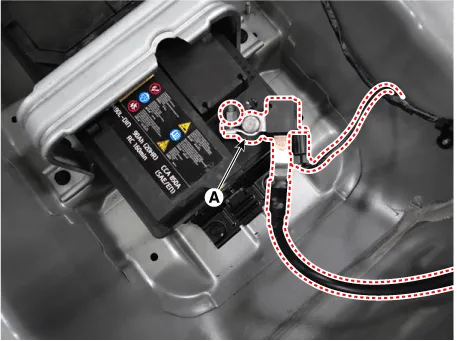
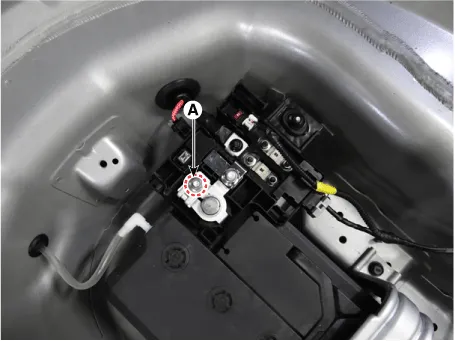
| 2. |
If the battery clamp on battery positive (+) terminal is not seated securely:
|
| 3. |
If the battery clamp on battery negative (-) terminal is not seated securely:
|
Battery Condition
Check the battery for damage or deformation. If severe damage, deformation or leakage is found, replace the battery.


Other information:
Kia Stinger (CK) 2018-2023 Service Manual: Blind-Spot Collision Warning (BCW) Radar Calibration
Repair procedures Inspection Correction Overview Need to calibrate the mounting angle of the BCW when a vehicle has a rear or a side collision with BCW system even just replacing a BCW bracket or BCW components. Check before Correction 1. When a failure code [C2702 (Master)] or [C2703 (Slave)] occurs, check the following before performing correction.Kia Stinger (CK) 2018-2023 Service Manual: Automatic Transmission Control System
Description and operation Description Automatic transmission control system relies on various measurements to determine the current control status and determine the necessary compensation values. These values are used to control the actuators and achieve the desired control output. Control System Composition Shift By Wire (SBW) System Composition ▶ Operating Principle – Instead of cable, the system uses electronic signals to shift between the P-R-N-D gears.Categories
- Manuals Home
- Kia Stinger Owners Manual
- Kia Stinger Service Manual
- New on site
- Most important about car
