
Kia Stinger CK: Charging System / DC DC converter
Components and components location
| Components Location |

Description and operation
| Description |
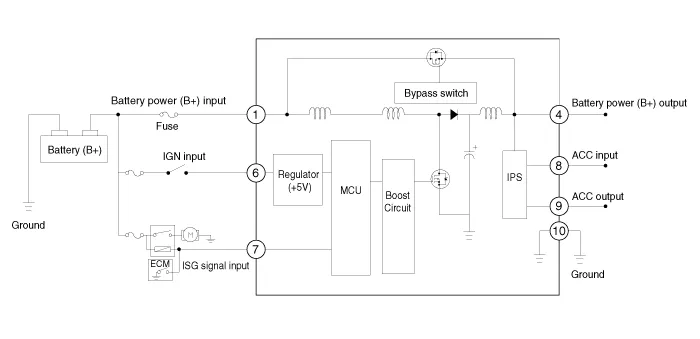
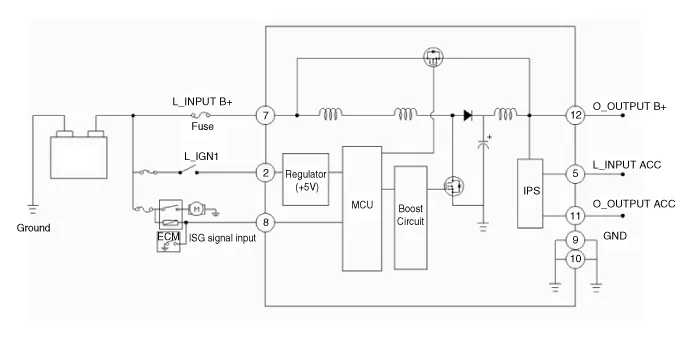
Due to the considerably more frequent occurrence of starting operations, the electrical load that occurs often leads to voltage dips in the vehicle network.In order to stabilize the power supply for certain voltage-sensitive electrical components, a DC/DC converter is used in conjunction with the ISG function.The DC DC converter supplies the relay with a voltage that also remains constant during the starting operation.
The DC/DC converter is fitted at the behind of the glove box.Via the test leads for input voltage and the start relay , the electronics decide whether the power is supplied to the output via the bypass or the DC/DC converter.In the bypass mode, the on-board supply voltage is not fed across the DC/DC converter, rather is transferred directly to the outputs. In the booster phase, the vehicle voltage is adapted.

Schematic diagrams
| Circuit Diagram |
| [200W] |
| [400W] |
| Terminal Function |
| [200W] |

|
PIn. |
Description |
PIn. |
Description |
|
1 |
Battery power (B+) input |
7 |
ISG signal input |
|
2 |
- |
8 |
ACC input |
|
3 |
- |
9 |
ACC output |
|
4 |
Battery power (B+) output |
10 |
Ground |
|
5 |
- |
11 |
- |
|
6 |
IGN1 input |
|
|
| [400W] |

|
PIn. |
Description |
PIn. |
Description |
|
1 |
- |
7 |
Battery power (B+) input |
|
2 |
IGN1 input |
8 |
ISG signal input |
|
3 |
- |
9 |
Ground |
|
4 |
- |
10 |
Ground |
|
5 |
ACC input |
11 |
ACC output |
|
6 |
- |
12 |
Battery power (B+) output |
Repair procedures
| Removal |
| [200W] |
| 1. |
Switch "OFF" the ignition and disconnect the negative (-) battery terminal. |
| 2. |
Remove the glove box housing. (Refer to Body (Interior and Exterior) - "Glove Box Housing") |
| 3. |
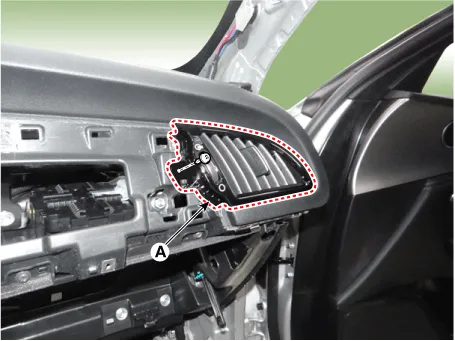
Remove the [RH] side air bant duct (A) after loosening the mounting screw.
|
| 4. |
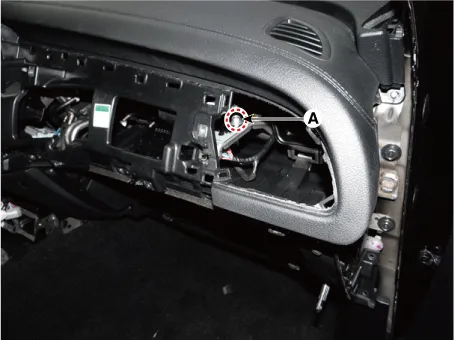
Remove the DC/DC converter after loosening the mounting bolt (A) and nut(B).
|
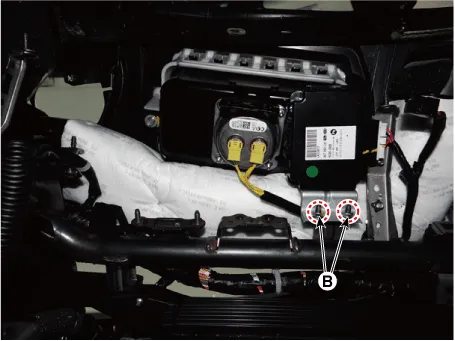
| [400W] |
| 1. |
Switch "OFF" the ignition and disconnect the negative (-) battery terminal. |
| 2. |
Disconnect the DC/DC converter connector (A).
|
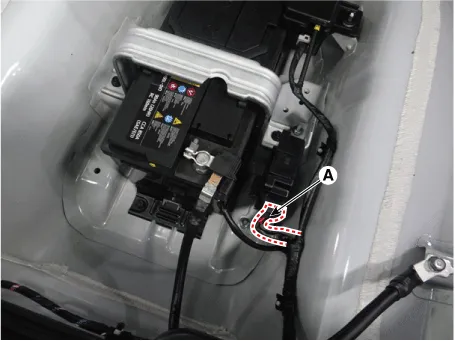
| 3. |
Remove the DC/DC converter (A) after loosening the mounting nuts.
|
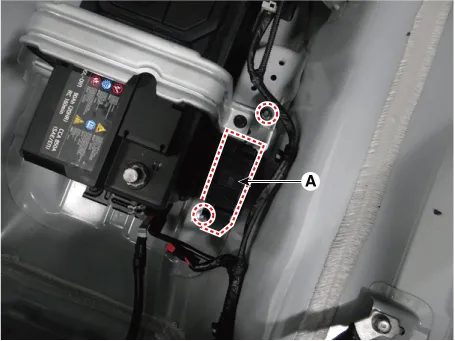
| Installation |
After reconnecting the battery negative cable, ISG function does not operates until the system is stabilized, about 4 hours. If disconnecting the negative (-) battery cable from the battery during repair work for the vehicle equipped with AMS function, Battery sensor recalibration procedure should be performed after finishing the repair work. |

| 1. |
Install in the reverse order of removal. |


Other information:
Kia Stinger (CK) 2018-2023 Service Manual: Driver Airbag (DAB) Module and Clock Spring
Description and operation Description Driver Airbag (DAB) is installed in the steering wheel and electrically connected to SRSCM via the clock spring. It protects the driver by deploying the airbag when frontal crash occurs. The SRSCM determines deployment of the Driver Airbag (DAB). Never attempt to measure the circuit resistance of the airbag module (squib) even if you are using the specified tester.Repair procedures Removal 1. Remove the engine room front under cover and side cover. (Refer to Engine and Transmission Assembly - "Engine Room Under Cover") 2. Drain the engine oil. (Refer to Lubrication System - "Engine Oil") 3. Remove the engine mounting support bracket nut (A).Categories
- Manuals Home
- Kia Stinger Owners Manual
- Kia Stinger Service Manual
- New on site
- Most important about car
