
Kia Stinger CK: Engine Electrical System / Starting System
Contents:
Description and operation
| Description |
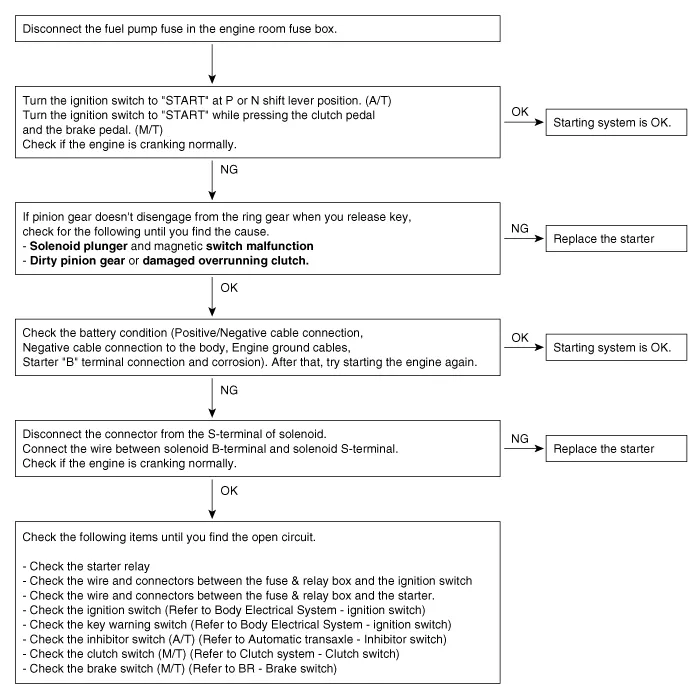
The starting system includes the battery, starter, solenoid switch, ignition switch, inhibitor switch (A/T), clutch pedal switch (M/T), ignition lock switch, connection wires and the battery cable.
When the ignition key is turned to the start position, current flows and energizes the starter motor's solenoid coil.
The solenoid plunger and clutch shift lever are activated, and the clutch pinion engages the ring gear.
The contacts close and the starter motor cranks.
In order to prevent damage caused by excessive rotation of the starter armature when the engine starts, the clutch pinion gear overruns.
Troubleshooting
| Troubleshooting |
|
Symptom |
Suspect Area |
Remedy |
|
Engine will not crank |
Battery charge low |
Charge or replace battery |
|
Battery cables loose, corroded or worn out |
Repair or replace cables |
|
|
Transaxle range switch (Vehicle with automatic transaxle only) |
Refer to AT group-automatic transaxle |
|
|
Fuse blown |
Replace fuse |
|
|
Starter motor faulty |
Replace |
|
|
Ignition switch faulty |
Replace |
|
|
Engine cranks slowly |
Battery charge low |
Charge or replace battery |
|
Battery cables loose, corroded or worn out |
Repair or replace cables |
|
|
Starter motor faulty |
Replace |
|
|
Starter keeps running |
Starter motor faulty |
Replace |
|
Ignition switch |
Replace |
|
|
Starter spins but engine will not crank |
Short in wiring |
Repair or replace wiring |
|
Pinion gear teeth broken or starter motor |
Replace |
|
|
Ring gear teeth broken |
Replace fly wheel or torque converter |
|

Starter ➤
Starter Relay ➤


Other information:
Kia Stinger (CK) 2018-2023 Service Manual: Roof Side Molding
Repair procedures Replacement Put on gloves to protect your hands. • Use a plastic panel removal tool to remove interior trim pieces without marring the surface.Kia Stinger (CK) 2018-2023 Service Manual: Smart Cruise Control (Stop & Go) (SCC) Switch
Components and components location Components 1. Left Remote Control Switch (Audio + Bluetooth + Voice) 2. Right Remote Control Switch (Trip Computer + ACC + SCC) Schematic diagrams Circuit Diagram [Audio + Bluetooth + Voice] [Trip + ACC] [Trip + ACC + SCC] Repair procedures Inspection 1.Categories
- Manuals Home
- Kia Stinger Owners Manual
- Kia Stinger Service Manual
- New on site
- Most important about car
Contents
