
Kia Stinger CK: Steering wheel / Tilt and telescopic steering
Tilt and telescopic steering allows you to adjust the steering wheel before you drive.You can also raise it to give your legs more room when you exit and enter the vehicle.
The steering wheel should be positioned so that it is comfortable for you to drive, while permitting you to see the instrument panel warning lights and gauges.
WARNING - Steering wheel adjustment
Never adjust the angle and height of the steering wheel while driving. You may lose steering control.
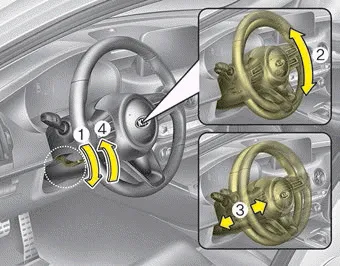
►Manual type
To change the steering wheel angle, pull down the lock-release lever (1), adjust the steering wheel to the desired angle (2) and height (3) then pull up the lock-release lever to lock (4) the steering wheel in place. Be sure to adjust the steering wheel to the desired position before driving.
✽ NOTICE
After adjustment, sometimes the lock release lever may not lock the steering wheel. It is not a malfunction. This occurs when two gears are not engaged correctly. In this case, adjust the steering wheel again and then lock the steering wheel.
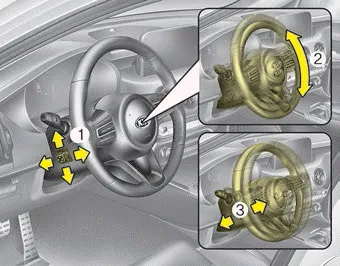
►Electric type
Adjust the steering wheel angle (2) and position (3) with the switch (1) on the steering column. Move the steering wheel, so it points toward your chest, not toward your face. Make sure you can see the instrument panel warning lights and gauges.
After adjusting, push the steering wheel both up and down to be certain it is locked in position. Always adjust the position of the steering wheel before driving.
✽ NOTICE
To prevent discharge of the battery, do not operate when the engine is stopped.


Other information:
Kia Stinger (CK) 2018-2023 Owner's Manual: Oil Cooler
Repair procedures Removal 1. Drain the coolant. (Refer to Cooling System - "Coolant") 2. Remove the oil filter. (Refer to Lubrication System - "Engine Oil") 3. Disconnect the oil cooler coolant hoses (A). 4. Loosen the mounting bolt (B) and remove the oil cooler assembly (C).Kia Stinger (CK) 2018-2023 Owner's Manual: Fuel Pump Control Module (FPCM)
Description and operation Description Installed on the righthand side of the fuel tank, the fuel pump control module (FPCM) controls the DC motor mounted inside the low pressure fuel pump. The module compares instantaneous fuel pressure information measured by the fuel pressure sensor (FPS) with target fuel pressure information provided by the ECM and generates the desired target fuel pressure by controlling the fuel pump motor and regulating fuel flow rate in the low pressure fuel line between the low and high pressure fuel pumps.Categories
- Manuals Home
- Kia Stinger Owners Manual
- Kia Stinger Service Manual
- New on site
- Most important about car
