
Kia Stinger CK: Manual heating and air conditioning / Mode selection
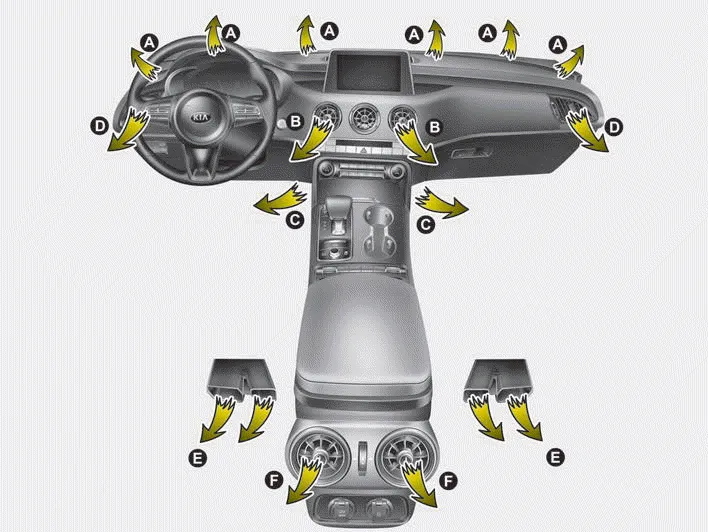

The mode selection button controls the direction of the air flow through the ventilation system.
The air flow outlet port is converted as follows:

Face-Level (B, D, F)

Air flow is directed toward the upper body and face. Additionally, each outlet can be controlled to direct the air discharged from the outlet.
Bi-Level (B, C, D, E, F)

Air flow is directed towards the face and the floor.
Floor-Level (A, C, E, F)

Most of the air flow is directed to the floor, with a small amount of the air being directed to the windshield and side window defrosters.
Floor/Defrost-Level (A, C, D, E, F)

Most of the air flow is directed to the floor and the windshield with a small amount directed to the side window defrosters.
Defrost-Level

Most of the air flow is directed to the windshield with a small amount of air directed to the side window defrosters.
Instrument panel vents
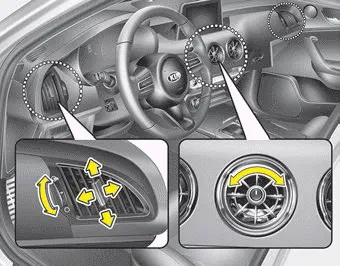
The outlet vents can be opened or closed separately using the thumbwheel (if equipped).
Also, you can adjust the direction of air delivery from these vents using the vent control lever as shown.


Other information:
Kia Stinger (CK) 2018-2023 Owner's Manual: Audio Front Monitor
Components and components location Components Repair procedures Removal • When removing with a flat-tip screwdriver or remover, wrap protective tape around the tools to prevent damage to components. • When removing the interior trim pieces, use a plastic panel removal tool not to damage the surface.Kia Stinger (CK) 2018-2023 Owner's Manual: Adaptive Front-Lighting System (AFS) Unit
Components and components location Components Schematic diagrams Schematic Diagrams Description and operation Description AFS Unit (ECU) AFS located in Cockpit Module is provided information of vehicle (steering wheel signal, vehicle speed, inclination of vehicle). Based on provided information, it calculates algorithm and adjust Low beam of H/Lamp.Categories
- Manuals Home
- Kia Stinger Owners Manual
- Kia Stinger Service Manual
- New on site
- Most important about car
