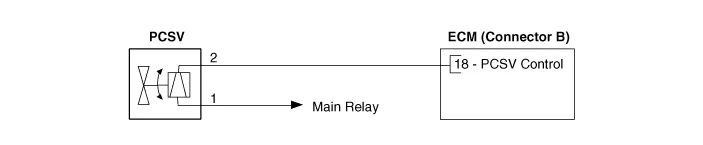
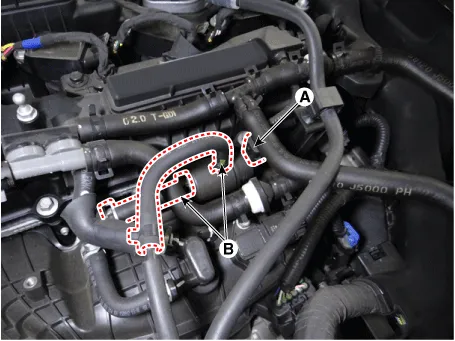
Installed on the surge tank, the Purge Control Solenoid Valve (PCSV) controls
the passage between the canister and the intake manifold. This solenoid valve is
open when the ECM grounds the valve control line. When the passage is open (PCSV
ON), fuel vapor stored in the canister is transferred to the intake manifold.
Other information:
Kia Stinger (CK) 2018-2023 Service Manual: Side Impact Sensor (SIS)
Description and operation
Description
•
Side Impact Sensor (SIS) system consists of two Pressure Side Impact
Sensor (P-SIS) installed at each center of the front door module (LH and
RH), two SIS installed at each center pillar nearby (LH and RH) and two
rear SIS installed in the rear pillar (LH and RH).
•
Pressure Side Impact Sensor is also called P-SIS because it detects pressure
from collision at its mounting location.
Kia Stinger (CK) 2018-2023 Service Manual: Emergency liftgate safety release
Your vehicle is equipped with the emergency liftgate safety release lever located
on the bottom of the liftgate. When someone is inadvertently locked in the luggage
compartment, the liftgate can be opened by doing as follows:
1. Remove the cover.
2. Push the release lever to the right.
3. Push up the liftgate.
WARNING
For emergencies, be fully aware of the location of the emergency liftgate
safety release lever in the vehicle and how to open the liftgate if you are
accidentally locked in the luggage compartment.