
Kia Stinger CK: Specifications & Consumer information / Recommended lubricants and capacities
To help achieve proper engine and powertrain performance and durability, use only lubricants of the proper quality. The correct lubricants also help promote engine efficiency that results in improved fuel economy.
These lubricants and fluids are recommended for use in your vehicle.
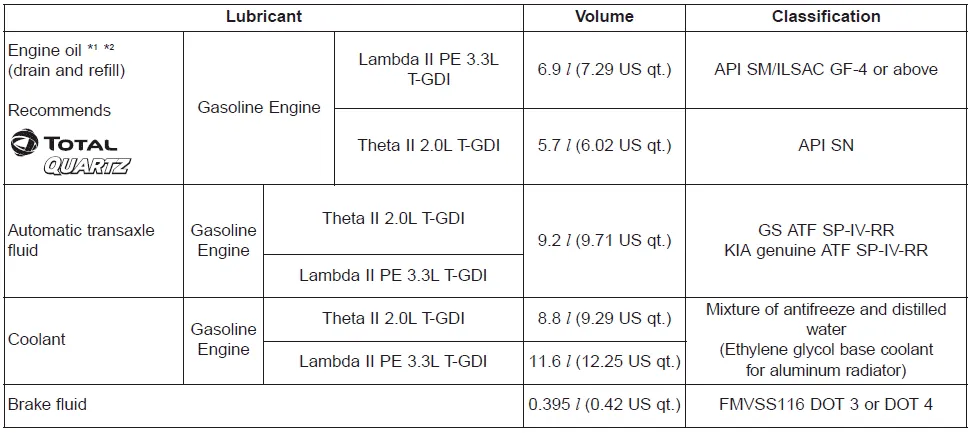
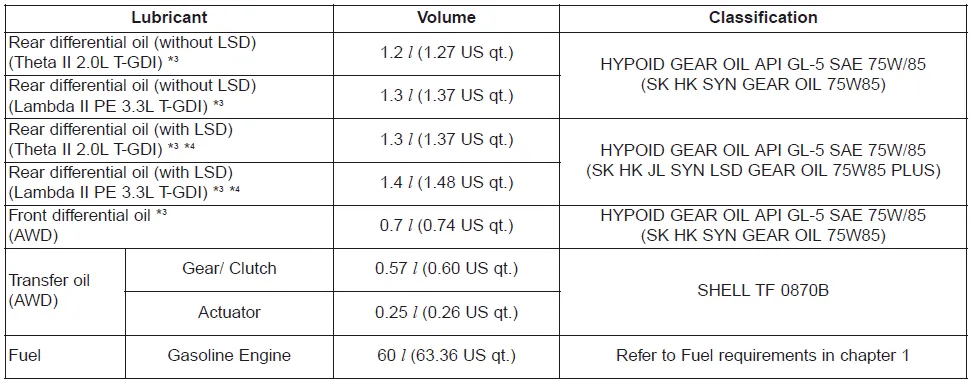
*1 : Refer to the recommended SAE viscosity numbers on the next page.
*2 : Engine oils labeled Energy Conserving Oil are now available. Along with other
additional benefits, they contribute to fuel economy by reducing the amount of fuel
necessary to overcome engine friction. Often, these improvements are difficult to
measure in everyday driving, but in a year’s time, they can offer significant cost
and energy savings.
*3 : Regardless of oil change intervals, replace oil immediately if Rear-Differential
or Front-Differential is submerged.
*4 : Be sure to inject oil for exclusive use of LSD when replacing Rear Differential
(for LSD) Oil.
Recommended SAE viscosity number
Engine oil viscosity (thickness) has an effect on fuel economy and cold weather operating (engine start and engine oil flowability). Lower viscosity engine oils can provide better fuel economy and cold weather performance; however, higher viscosity engine oils are required for satisfactory lubrication in hot weather. Using oils of any viscosity other than those recommended could result in engine damage. When choosing an oil, consider the range of temperature your vehicle will be operated in before the next oil change. Proceed to select the recommended oil viscosity from the chart.
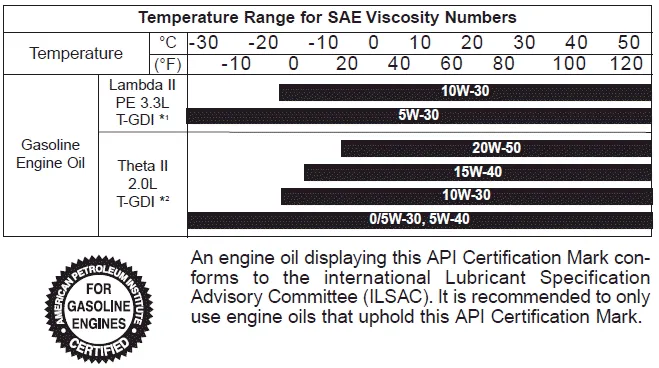
*1 : For better fuel economy, it is recommended to use the engine oil of a viscosity
grade SAE 5W 30 (API SM/ILSAC GF-4 or above). However, if the engine oil is not
available in your country, select the proper engine oil using the engine oil viscosity
chart.
*2 : For better fuel economy, it is recommended to use the engine oil of a viscosity
grade SAE 0W 30 (API SN or above). However, if the engine oil is not available in
your country, select the proper engine oil using the engine oil viscosity chart.


Other information:
Kia Stinger (CK) 2018-2023 Owner's Manual: Cruise control system
The cruise control system allows you to program the vehicle to maintain a constant speed without depressing the accelerator pedal. This system is designed to function above approximately 30 km/h (20 mph ). If the cruise control is left on, (cruise indicator light is illuminated), the cruise control can be switched on accidentally. Keep the cruise control system off when the cruise control is not in use, to avoid inadvertently setting a speed.Kia Stinger (CK) 2018-2023 Owner's Manual: Good driving practices
Never move the shift lever from P (Park) or N (Neutral) to any other position with the accelerator pedal depressed. Never move the shift lever into P (Park) when the vehicle is in motion. Be sure the vehicle is completely stopped before you attempt to shift into R (Reverse) or D (Drive). Do not move the shift lever to N (Neutral) when driving.Categories
- Manuals Home
- Kia Stinger Owners Manual
- Kia Stinger Service Manual
- New on site
- Most important about car
