
Kia Stinger CK: LCD windows / Trip information (Trip computer)
Contents:
- Trip Modes
- Fuel Economy
- Accumulated driving information mode
- One time driving information mode
- Digital speedometer
- Smart Shift
The trip computer is a microcomputer- controlled driver information system that displays information related to driving.
✽ NOTICE
Some driving information stored in the trip computer (for example Average Fuel Economy) resets if the battery is disconnected.
Trip Modes
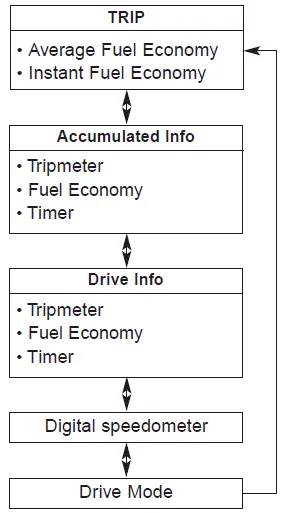
Fuel Economy ➤
Accumulated driving information mode
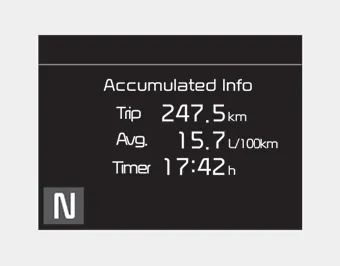
Displays accumulated information starting from mileage/fuel efficiency/time default point.
- Accumulated information is calculated after the vehicle has run for more than 300 meters (0.19 mi).
- If you press “OK” button for more than 1 second after the Cumulative Information is displayed, the information will be reset.
- If the engine is running, even when the vehicle is not in motion, the information will be accumulated.
One time driving information mode
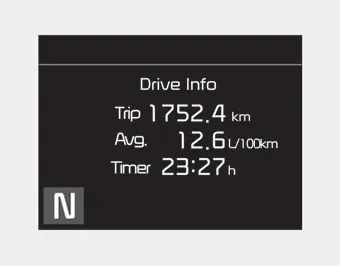
The vehicle will display Driving Information once per one ignition cycle.
- Fuel efficiency is calculated after the vehicle has run for more than 300 meters
(0.19 mi).
- The Driving Information will be reset 4 hours after ignition has been turned off.
So, when the vehicle ignition is turned on within 4 hours, the information will
not be reset.
- If you press “OK” button for more than 1 second after the Driving Information
is displayed, the information will be reset.
- If the engine is running, even when the vehicle is not in motion, the information
will be accumulated.
Digital speedometer
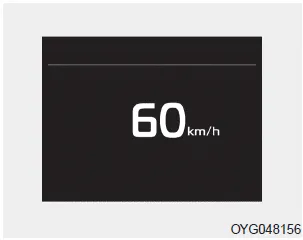
This mode displays the current speed of the vehicle.
Smart Shift
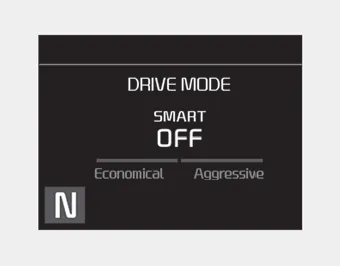
This mode displays the currently selected drive mode.


Other information:
Kia Stinger (CK) 2018-2023 Owner's Manual: Climate Control Air Filter
Repair procedures Filter inspection The climate control air filter should be replaced according to the maintenance schedule. If the vehicle is operated in severely polluted city or on dusty rough roads for a long period, it should be inspected more frequently and replaced earlier than schedule. When replacing the climate control air filter, replace in the following procedure and be careful not to damage other components.Service data Service data Item Specification Master cylinder Type Tandem Cylinder I.D. Ø 23.81 mm (0.937 in) Piston stroke 36±1 mm (1.41 ± 0.039 in) Fluid level switch Provided Brake booster Type 8+8" Tandem Boosting ratio 9 : 1 Front disc brake (17 in) Type Ventilated disc Disc O.Categories
- Manuals Home
- Kia Stinger Owners Manual
- Kia Stinger Service Manual
- Trip Modes
- Fuel Economy
- Accumulated driving information mode
- One time driving information mode
- Digital speedometer
- Smart Shift
- New on site
- Most important about car
Contents
