
Kia Stinger CK: Suspension System / Tire Pressure Monitoring System
Contents:
Components and components location
| Components |
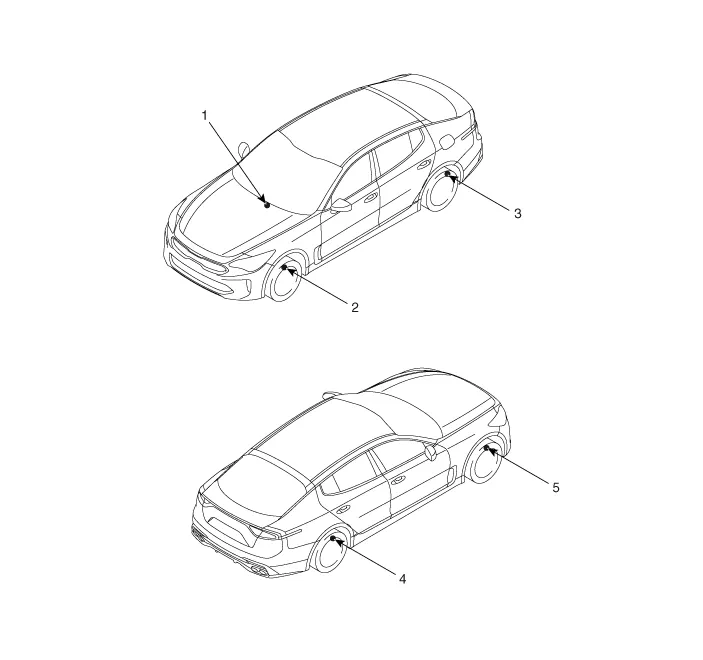
| 1. IBU(TPMS) 2. TPMS sensor (FL) 3. TPMS sensor (RL) |
4. TPMS sensor (RR) 5. TPMS sensor (FR) |
Description and operation
| Description |
TREAD Lamp
| – |
Tire Under Inflation / Leak Warning.
|

| 1. |
Turn on condition
|
| 2. |
Turn off condition
|
DTC Warning
| 1. |
Turn on condition
|
| 2. |
Turn off condition
|
|

System Fault
| 1. |
General Function
|
Troubleshooting
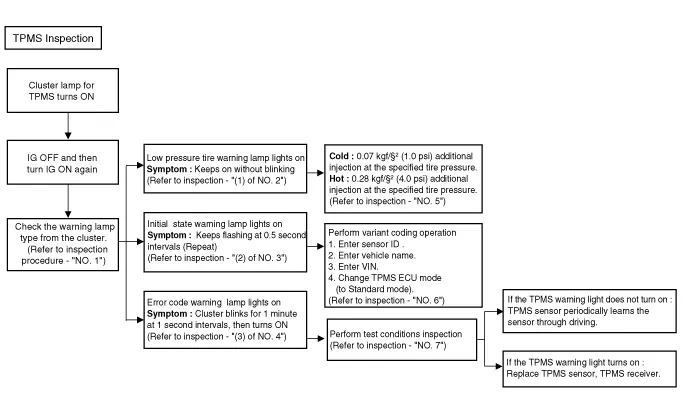
| TPMS Inspection method |
| Inspection |
Find the inspection number by referring to the table above. The following content is irrelevant of the inspection procedure. |
| 1. |
Warning lamp types
|
| 2. |
(1) Check the warning lamp state.
|
| 3. |
(2) Check the warning lamp state.
|

| 4. |
(3) Check the warning lamp state.
|
| 5. |
Low tire pressure warning lamp Cold : Vehicle kept for more than 60 minutes after stopping. → 0.07 kgf/cm² (1.0 psi) additional injection at the specified tire pressure. Hot : Driven vehicle → 0.28 kgf/cm² (4.0 psi) additional injection at the specified tire pressure.
|
| 6. |
Inspect initial state warning lamp
|
| 7. |
DTC checklist for performance test.
|
TPMS Sensor ➤
TPMS Receiver ➤


Other information:
Repair procedures Removal • Put on gloves to prevent hand injuries. • When removing with a flat-tip screwdriver or remover, wrap protective tape around the tools to prevent damage to components.Repair procedures Automatic Transmission Fluid (ATF) Level Check 1. Start the engine to warm up the ATF. Do not step on the brake and accelerator simultaneously to warm up the ATF. 2.Categories
- Manuals Home
- Kia Stinger Owners Manual
- Kia Stinger Service Manual
- New on site
- Most important about car
Contents
