
Kia Stinger CK: Seat / Rear seat adjustment
Contents:
Headrest
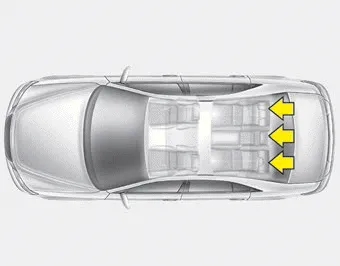
The rear seat is equipped with headrests in all the seating positions for the occupant's safety and comfort.
The headrest not only provides comfort for passengers, but also helps protect the head and neck in the event of a collision.
For maximum effectiveness in case of an accident, the headrest should be adjusted so the middle of the headrest is at the same height of the center of gravity of an occupant's head. Generally, the center of gravity of most people's heads is similar with the height as the top of their eyes.
Also, adjust the headrest as close to your head as possible. For this reason, the use of a cushion that holds the body away from the seatback is not recommended.
Adjusting the height up and down
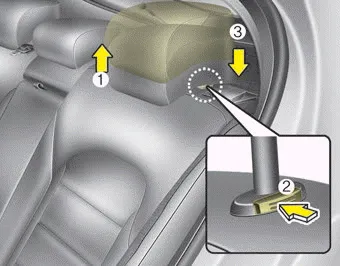
To raise the headrest, pull it up to the desired position (1). To lower the headrest, push and hold the release button (2) on the headrest support and lower the headrest to the desired position (3).
Removal and reinstallation
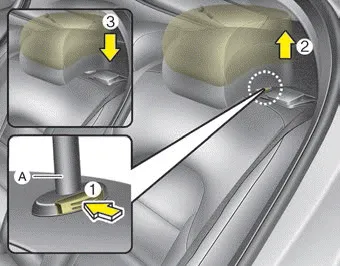
To remove the headrest, raise it as far as it can go then press the release button (1) while pulling the headrest upward (2).
To reinstall the headrest, put the headrest poles (3) into the holes while pressing the release button (1). Then adjust it to the appropriate height and ensure that it locks in position.
Armrest
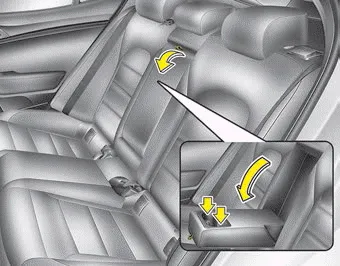
To use the armrest, pull it forward from the seatback.
Folding the rear seat ➤


Other information:
Driver`s seat (1) Driver position memory system* (2) Forward and backward (3) Seatback angle (4) Seat cushion height (5) Lumbar support (6) Cushion extension (7) Seat back bolster control (8) Headrest Front Passenger`s seat (9) Forward and backward (10) Seatback angle (11) Seat cushion height (12) Lumbar support (13) Headrest Rear seat (14) Armrest (15) Headrest (16) Seatback folding lever WARNING - Loose objects Do not place anything in the driver's foot well or under the front seats.Repair procedures Replacement Oil Seal (Main Shaft) 1. Remove the transfer case assembly. (Refer to 4 Wheel Drive (AWD) System -"Transfer Case Assembly") 2. Remove the oil seal (A) using a flat head driver. • To prevent from oil leak at the Bentle Valve (B), replace the oil seal with the same installation direction of transfer case oil seal.Categories
- Manuals Home
- Kia Stinger Owners Manual
- Kia Stinger Service Manual
- New on site
- Most important about car
Contents
