
Kia Stinger CK: Air Conditioning System / Ambient Temperature Sensor
Description and operation
| Description |
Located in front of the condenser, the ambient temperature sensor detects the ambient air temperature. It is a negative type thermistor; resistance will increase with lower temperature, and decrease with higher temperature.
The sensor output will be used for discharging temperature control, temperature regulation door control, blower motor level control, mix mode control and in-car humidity control.
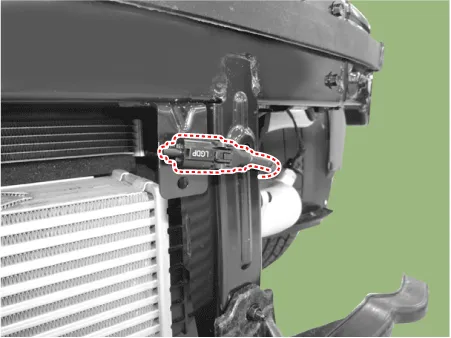
If the ambient temperature is below 2.0°C (35.6°F), the A/C compressor will stop. The compressor will operate manually. |

Repair procedures
| Inspection |
| 1. |
Turn the ignition switch OFF. |
| 2. |
Remove the front bumper assembly. (Refer to Body - "Front Bumper Assembly") |
| 3. |
Disconnect ambient temperature sensor. |
| 4. |
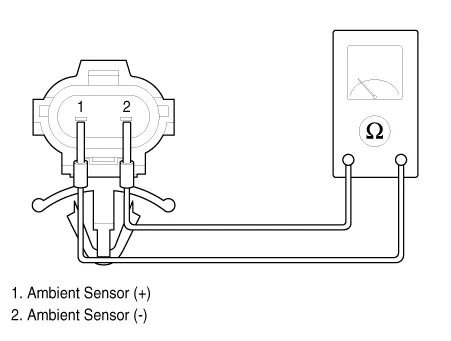
Check the resistance of the ambient temperature sensor between terminals 1 and 2 and see if it changes with the ambient temperature.
Specification
|
| 5. |
If the measured resistance is not within specification, substitute with a known-good ambient temperature sensor and check for proper operation. |
| 6. |
Replace the ambient temperature sensor if it is proved that there is a problem with the sensor. |
| Replacement |
| 1. |
Disconnect the negative (-) battery terminal. |
| 2. |
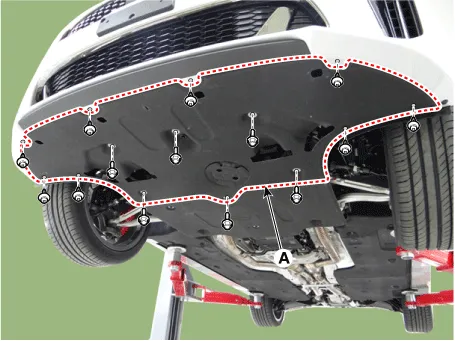
Remove the engine room under cover (A).
|
| 3. |
Disconnect the connector (A) and then remove the ambient temperature sensor (B).
|
| 4. |
Install in the reverse order of removal. |


Other information:
Kia Stinger (CK) 2018-2023 Service Manual: Center Fascia Panel
Components and components location Component Location 1. Monitor fascia panel Repair procedures Replacement Put on gloves to protect your hands. • Use a plastic panel removal tool to remove interior trim pieces without marring the surface.Kia Stinger (CK) 2018-2023 Service Manual: Parking Brake & Brake Fluid Warning Light
This warning light illuminates: Once you set the Engine Start/Stop Button to the ON position. - It illuminates for approximately 3 seconds When the parking brake is applied, the warning light will remain on. When the brake fluid level in the reservoir is low. - If the warning light illuminates with the parking brake released, it indicates the brake fluid level in reservoir is low.Categories
- Manuals Home
- Kia Stinger Owners Manual
- Kia Stinger Service Manual
- New on site
- Most important about car
