Kia Stinger CK: Engine Control System / Purge Control Solenoid Valve (PCSV)
Specifications
Item
|
Specification
|
Coil Resistance (Ω)
|
18.5 - 22.5 [20°C(68°F)]
|
Description and operation
Installed on the surge tank, the Purge Control Solenoid Valve (PCSV) controls
the passage between the canister and the intake manifold. This solenoid valve is
open when the ECM grounds the valve control line. When the passage is open (PCSV
ON), fuel vapor stored in the canister is transferred to the intake manifold.

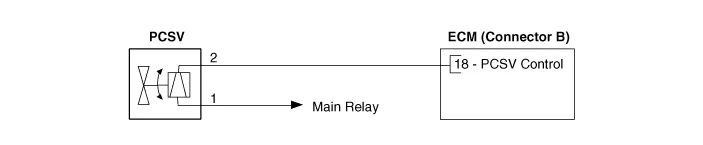
Schematic diagrams

Repair procedures
| 1. |
Switch "OFF" the ignition.
|
| 2. |
Disconnect the PCSV connector.
|
| 3. |
Measure resistance between the PCSV terminals 1 and 2.
|
| 4. |
Check that the resistance is within the specification.
|
Specification: 22.0 - 26.0 Ω [20°C(68°F)]
|
|
| 1. |
Switch "OFF" the ignition and disconnect the negative (-) battery terminal.
|
| 2. |
Remove the engine cover.
(Refer to Engine Mechanical System - "Engine Cover")
|
| 3. |
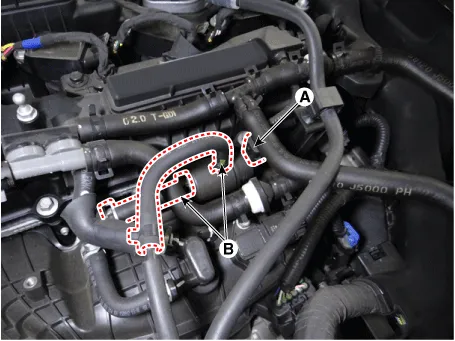
Disconnect the purge control solenoid valve connector (A).
|
| 4. |
Disconnect the vapor hoses (B) from the purge control solenoid valve.
|
| • |
Install the component to the specified torques.
|
| • |
Note that internal damage may occur when the component is dropped.
If the component has been dropped, inspect before installing.
|
| • |
Take caution to keep foreign materials out of the valve.
|
|
| 1. |
Install in the reverse order of removal.
|