Kia Stinger CK: Rear Suspension System / Rear Assist Arm

Repair procedures
Removal
1.

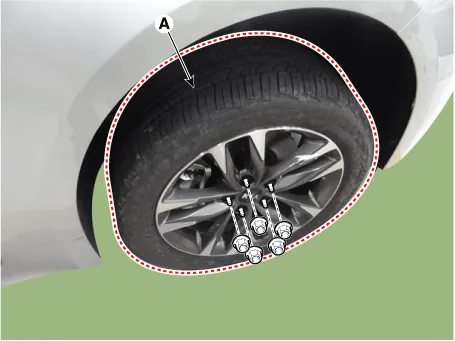
Remove wheel nuts, wheel and tire (A) from hub.

Tightening torque:

107.9 - 127.5 N·m (11.0 - 13.0 kgf·m, 79.6 - 94.0 lb·ft)


Be careful not to damage the wheel bolts when removing the wheel and tire (A).

2.

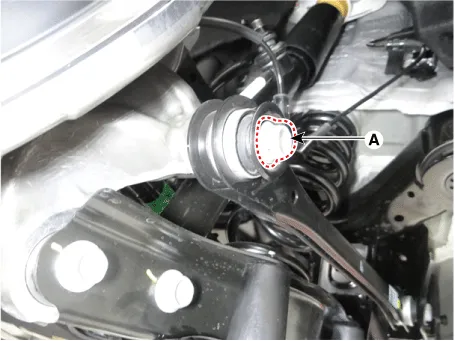
Loosen the bolt (A) and then separate the rear assist arm from the rear axle.

Tightening torque:

117.7 - 132.4 N·m (12.0 - 13.5 kgf·m, 86.8 - 97.6 lb·ft)


Up the transmission jack under the lower arm in order to remove the rear assist arm in no-load condition.

3.

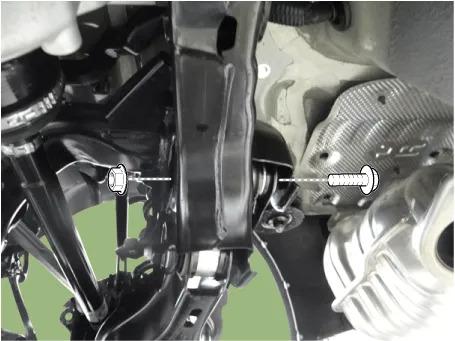
Loosen the bolt & nut and then remove the rear assist arm from the rear cross member.

Tightening torque :

137.3 - 156.9 N·m (14.0 - 16.0 kgf·m, 101.3 - 115.7 lb·ft)

4.

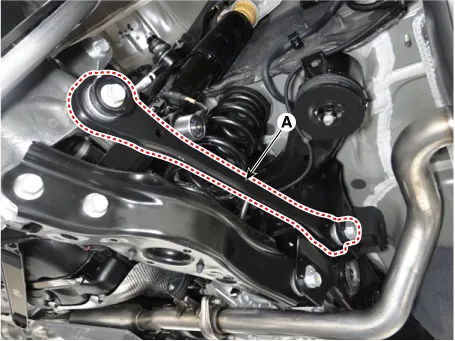
Install in the reverse order of removal.


Install at the empty vehicle height when it is assembled.

5.

Check the alignment.

(Refer to Suspension System - "Alignment")

Inspection
1.

Check the bushing for wear and deterioration.

2.

Check for all bolts and nuts.

Other information:

Kia Stinger (CK) 2018-2023 Service Manual: Starting System

Description and operation Description The starting system includes the battery, starter, solenoid switch, ignition switch, inhibitor switch (A/T), clutch pedal switch (M/T), ignition lock switch, connection wires and the battery cable. When the ignition key is turned to the start position, current flows and energizes the starter motor's solenoid coil.

Kia Stinger (CK) 2018-2023 Service Manual: Steering Angle Sensor

Description and operation Description Steering Wheel Angle Sensor detects rotating direction of the vehicle.The rotating direction detected by the sensor is sent to the HECU as CAN signal via CAN communication. HECU detects speed of the steering wheel handling and the angle with this CAN signal. HECU also uses this signal as the input signal to control anti-roll.

Categories

 
Copyright © 2026 www.kstinger.com 0.0087