
Kia Stinger CK: Rear Suspension System / Rear Stabilizer Bar
Repair procedures
| Removal |
| 1. |
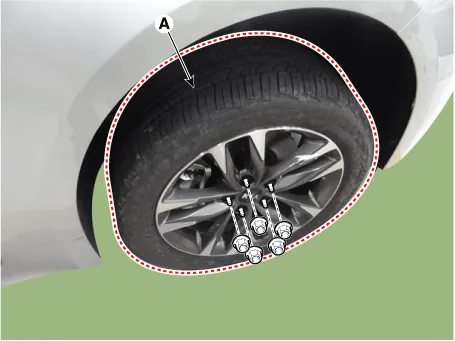
Remove wheel nuts, wheel and tire (A) from hub.
|

| 2. |
Remove the brake caliper. (Refer to Brake system - "Rear disc brake") |
| 3. |
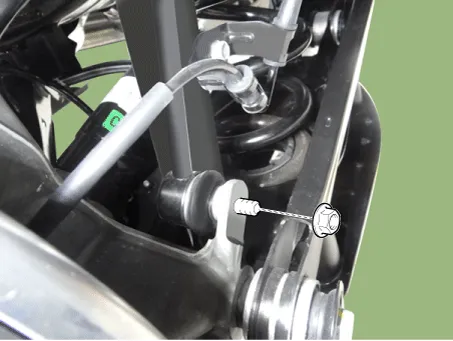
Loosen the stabilizer link nut and then separate the rear axle.
|
| 4. |
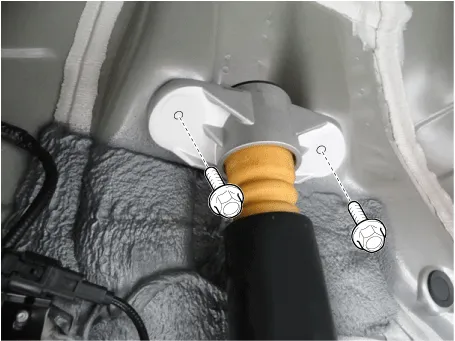
Loosen the rear shock absorber upper bolts and the remove the rear shock absorber.
|
| 5. |
Remove the propeller shaft. (Refer to Driveshaft and axle - "Propeller shaft") |
| 6. |
Remove the rear muffler. D 2.2 R VGT (Refer to Engine Mechanical System - "Muffler") G 2.0 T-GDI THETA II (Refer to Engine Mechanical System - "Muffler") G 3.3 T-GDI LAMBDA II (Refer to Engine Mechanical System - "Muffler") |
| 7. |
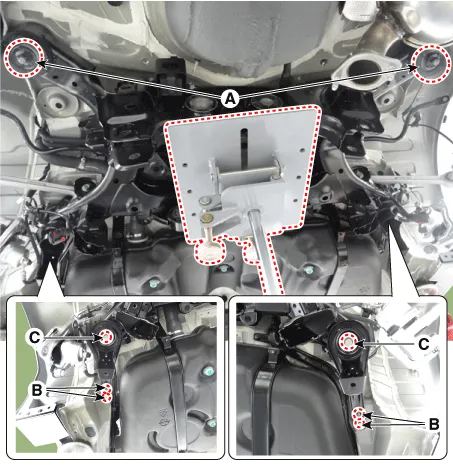
Loosen the rear cross member nuts & bolts and then remove the rear cross member.
|
| 8. |
Loosen the stabilizer bar nuts & bolts and then remove the stabilizer bar.
|
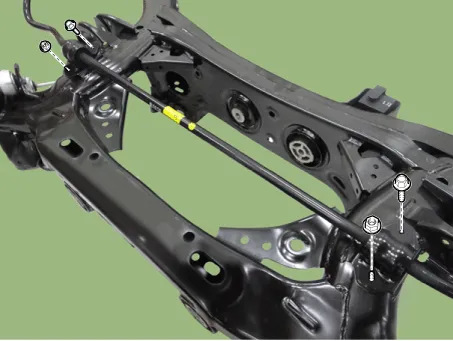
| 9. |
Install in the reverse order of removal. |
| 10. |
Check the alignment. (Refer to Suspension System - "Alignment") |
| Inspection |
| 1. |
Check the rear stabilizer bar for deformation. |
| 2. |
Check the rear stabilizer link ball joint for damage. |


Other information:
Components and components location Components 1. Radiator 2. Radiator upper hose 3. Radiator lower hose 4. Radiator upper mounting bracket (RH) 5. Radiator upper mounting bracket (LH) 6. Radiator lower mounting insulator (RH) 7. Radiator lower mounting insulator (LH) 8. Cooling fan assembly 9.Battery saver function The purpose of this feature is to prevent the battery from being discharged if the lights are left in the ON position. The system automatically shuts off the parking lights 30 seconds after the ignition key is removed and the driver’s door is opened and closed. With this feature, the parking lights will turn off automatically if the driver parks on the side of the road at night and opens the driver’s side door.Categories
- Manuals Home
- Kia Stinger Owners Manual
- Kia Stinger Service Manual
- New on site
- Most important about car
