
Kia Stinger CK: Heater / Console Temperature Control Actuator
Repair procedures
| Inspection |
| 1. |
Turn the ignition switch OFF. |
| 2. |
Disconnect the mode control actuator connector. |
| 3. |
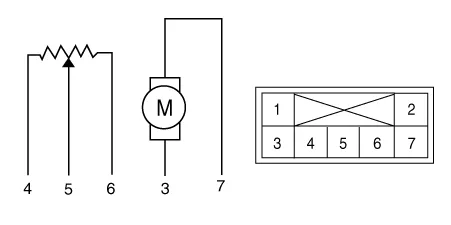
Verify that the mode control actuator operates to the defrost mode when 12V is connected to terminal 3 and ground to terminal 7. Verify that the mode control actuator operates to the vent mode when connected in reverse.
|
| 4. |
Connect the mode control actuator connector. |
| 5. |
Turn the ignition switch ON. |
| 6. |
Check the voltage between terminals 5 and 4. Specification
The current position of the actuator will be sent to the control unit. |
| 7. |
If the measured voltage is not within the specification, substitute with a verified temperature control actuator and check for proper operation. |
| 8. |
Replace the mode control actuator if it is proved that there is a problem with it. |
| Replacement |
| 1. |
Disconnect the negative (-) battery terminal. |
| 2. |
Remove the knee airbag. (Refer to Restraint - "Knee Airbag (KAB) Module") |
| 3. |
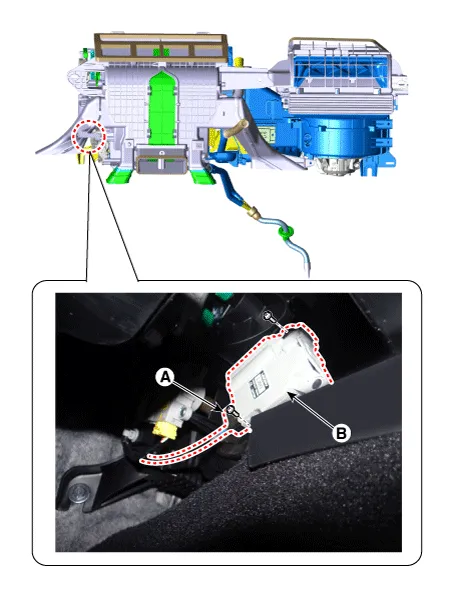
Disconnect the connector (A) and then remove the temperature control actuator (B) after loosening the mounting screws.
|
| 4. |
Install in the reverse order of removal. |


Other information:
Kia Stinger (CK) 2018-2023 Service Manual: Engine Room Under Cover
Repair procedures Removal and Installation Engine Room Front Under Cover. 1. Remove the engine room front under cover (A). Tightening torque : 7.8 - 11.8 N·m (0.8 - 1.2 kgf·m, 5.8 - 8.7 lb·ft) 2. Install in the reverse order of removal. Engine Room Rear Under Cover.Kia Stinger (CK) 2018-2023 Service Manual: Fuel Pump Control Module (FPCM)
Description and operation Description Installed on the righthand side of the fuel tank, the fuel pump control module (FPCM) controls the DC motor mounted inside the low pressure fuel pump. The module compares instantaneous fuel pressure information measured by the fuel pressure sensor (FPS) with target fuel pressure information provided by the ECM and generates the desired target fuel pressure by controlling the fuel pump motor and regulating fuel flow rate in the low pressure fuel line between the low and high pressure fuel pumps.Categories
- Manuals Home
- Kia Stinger Owners Manual
- Kia Stinger Service Manual
- New on site
- Most important about car
