
Kia Stinger CK: Automatic Transmission Control System / E-Shifter
Components and components location
| Components |

| 1. E-Shifter 2. Parking release actuator |
3. Parking release cable 4. Parking release lever |
Schematic diagrams
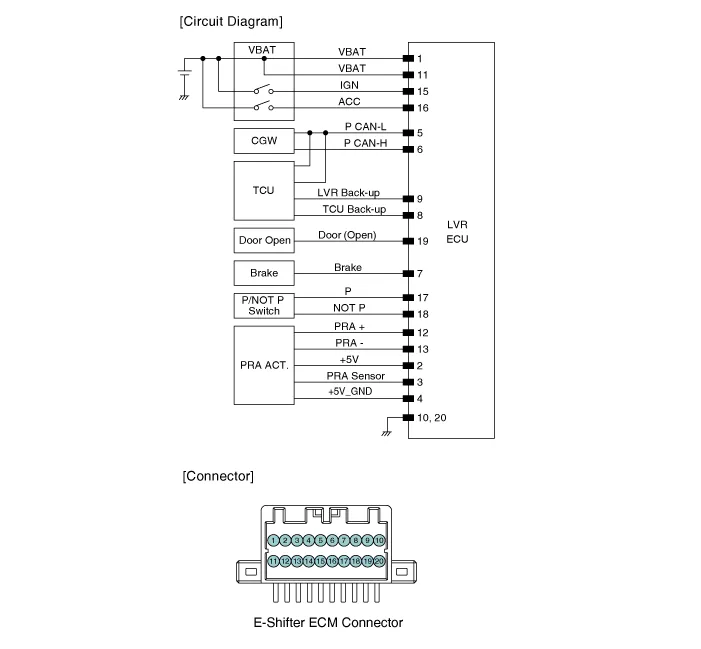
| Circuit Diagram |
Description and operation
| Description |
| • |
Operating Principle: Any change in the lever position is detected and transmitted via electric signals from the electronic shift lever ECU to the TCM. |
| • |
Function |
| – |
Gear shifting signal transmission |
| – |
Shift lever display |
| – |
Shift locking |
| – |
System failure diagnosis |
| • |
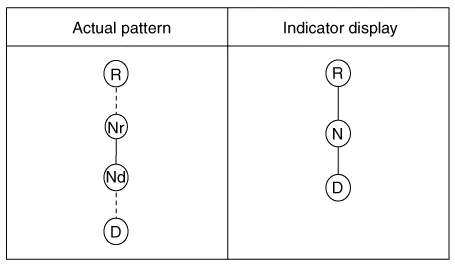
Electronic shift lever operation pattern
|
| • |
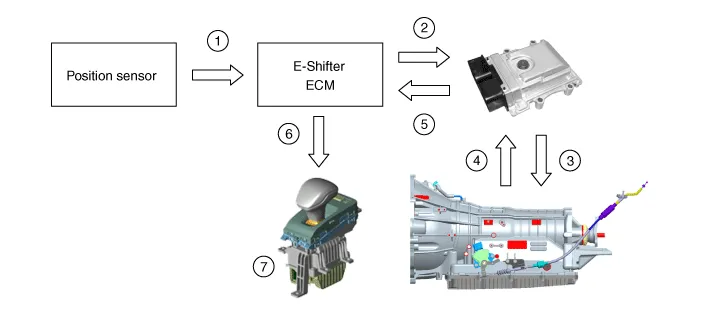
Operation order Flow diagram
|
| 1) |
The lever position is detected and the data is sent to the electronic shift lever ECM. |
| 2) |
The lever position information is transmitted from the electronic shift lever ECM to the TCM (CAN + Hard wire). |
| 3) |
The TCM controls the AT so that the mode reflects the lever position. |
| 4) |
The TCM checks the information on the final shift mode of the AT. |
| 5) |
The TCM sends the information on the final shift mode to the electronic shift lever ECM. (CAN) |
| 6) |
The Electronic shift lever ECM sends the information on final shift mode to the indicator. |
| 7) |
Current information on the final shift mode appears on the indicator. |
Repair procedures
| Removal |
| 1. |
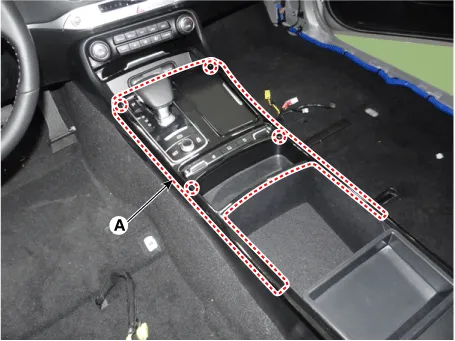
Remove the upper console cover (A) using the remover.
|
| 2. |
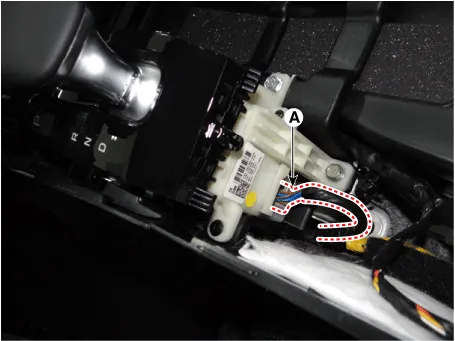
Disconnect the main connector (A).
|
| 3. |
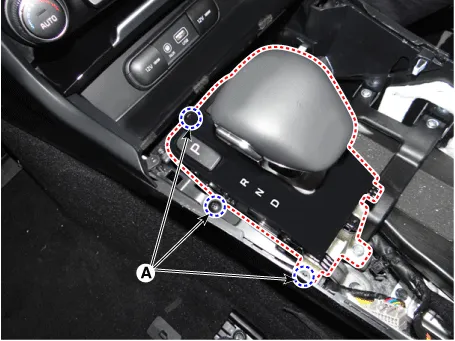
Loosen the E-shifter mounting screws (A).
|
| 4. |
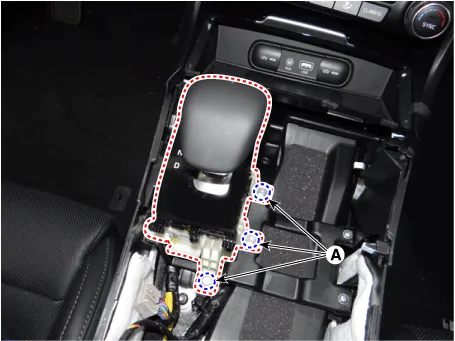
Loosen the E-shifter mounting bolts (A).
|
| Installation |
| 1. |
Install in the reverse order of removal. |


Other information:
Kia Stinger (CK) 2018-2023 Service Manual: Heating, Ventilation And Air Conditioning
Special service tools Special Service Tools Tool (Number and name) Illustration Use 09977-3R000 Disc & hub assembly bolt remover Removal and installation of disc & hub assembly. Troubleshooting Troubleshooting Problem Symptoms Table Before replacing or repairing air conditioning components, first determine if the malfunction is due to lack of refrigerant, air flow or compressor.Repair procedures Removal 1. Remove wheel nuts, wheel and tire (A) from hub. Tightening torque: 107.9 - 127.5 N·m (11.0 - 13.0 kgf·m, 79.6 - 94.0 lb·ft) Be careful not to damage the wheel bolts when removing the wheel and tire (A).Categories
- Manuals Home
- Kia Stinger Owners Manual
- Kia Stinger Service Manual
- New on site
- Most important about car
