Kia Stinger CK: Front Driveshaft Assembly / Front Driveshaft
Components and components location
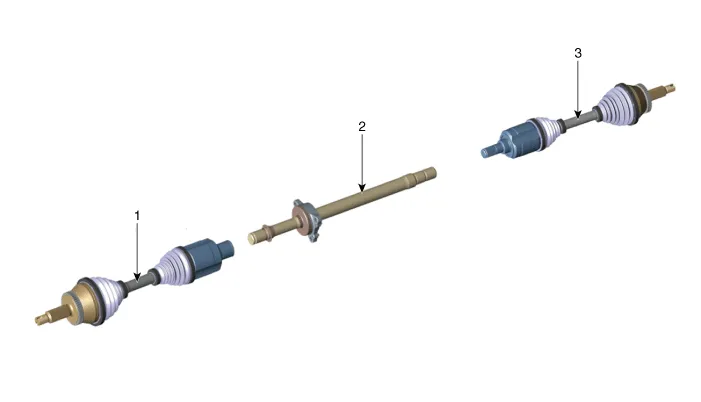
1. Front drive shaft [LH]
2. Front drive shaft bracket
|
3. Front drive shaft [RH]
|
Repair procedures
[3.3 T-GDI LAMBDA II
(LH)]
| 1. |
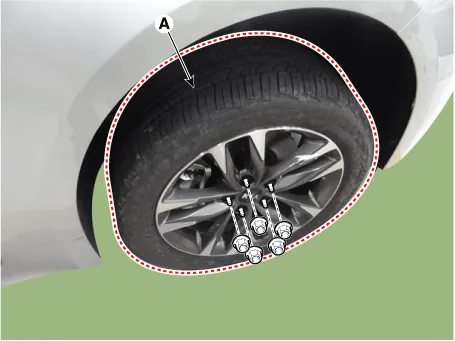
Remove wheel nuts, front wheel and tire (A) from front hub.
|
Tightening torque:
107.9 - 127.5 N·m (11.0 - 13.0 kgf·m, 79.6 - 94.0 lb·ft)
|
|
Be careful not to damage the wheel nuts when removing the front
wheel and tire (A).
|
|
| 2. |
Separate the air con compressor.
(Refer to Heating,Ventilation And Air Conditioning - "Compressor")
|
| 3. |
Remove the front brake caliper.
(Refer to Brake System - "Front Disc Brake")
|
| 4. |
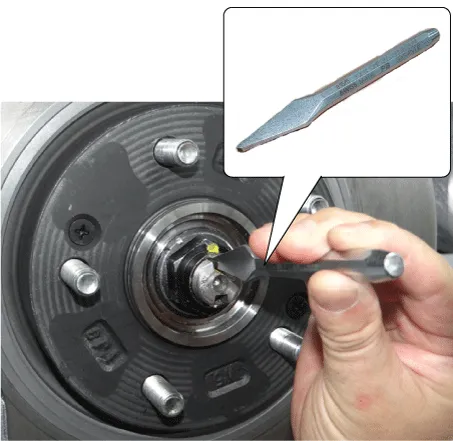
By hammering on a chisel, unlock the drive shaft lock hub nut caulking.
|
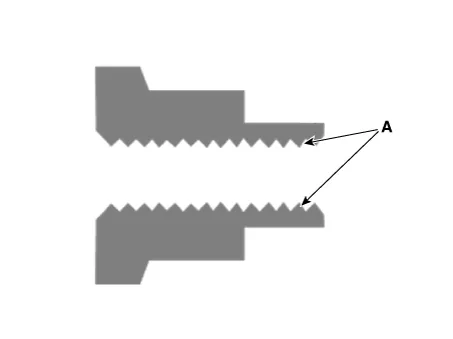
If there is screw thread (A) on the end of the nut, unlock the
caulking by using a chisel and then loosen the nut to prevent damaging
driveshaft screw thread.
|
|
| 5. |
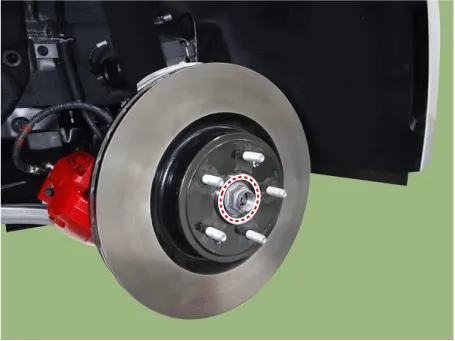
Loosen the caulking nut and then separate the hub assembly from the drive
shaft.
|
Tightening torque :
294.2 - 313.8 N·m (30.0 - 32.0 kgf·m, 217.0 - 231.5 lb·ft)
|
| •
|
Use plastic hammer to avoid damaging on axle when the
drive shaft is disassembled.
|
| •
|
Do not pull or twist excessively to remove the axle when
the drive shaft is disassembled.
|
|
|
The driveshaft lock nut must be replaced with new one.
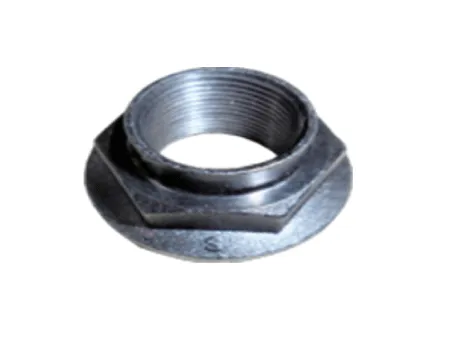
When replacing the drive lock hub nut, use only the nut with
screw thread (A) on the end.
| •
|
Tighten the driveshaft lock hub nut to the specified
tightening torque, and caulk by using a chisel and hammer.
|
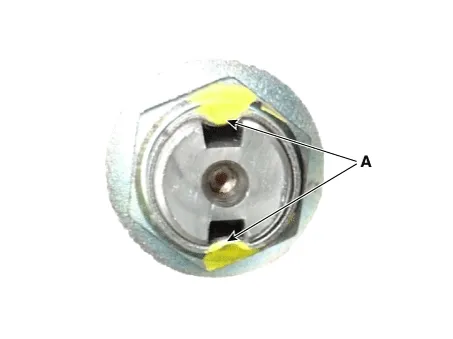
| •
|
If there are two key seats, perform on all two seats.
Caulking depth (A) : 1.5 mm (0.0591 in)
|
|
|
| 6. |
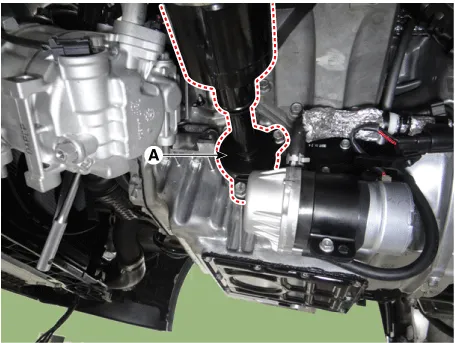
Remove the front drive shaft bracket (A) from the front differential
and then using pry bar, remove the front drive shaft [LH].
|
Tightening torque :
49.0 - 63.7 N·m (5.0 - 6.5 kgf·m, 36.2.0 - 47.0 lb·ft)
|
|
| 7. |
Install in the reverse order of removal.
| •
|
Use a pry bar being careful not to damage the transaxle
and joint.
|
| •
|
Do not insert the pry bar too deep, as this may cause
damage to the oil seal.
|
| •
|
Do not pull the driveshaft by excessive force it may
cause components inside the joint kit to dislodge resulting
in a torn boot or a damaged bearing.
|
| •
|
Plug the hole of the transaxle case with the oil seal
cap to prevent contamination.
|
| •
|
Support the driveshaft properly.
- Be careful that the drive shaft is not bent or drop
down by other component's weight (such as axle etc.)
|
| •
|
Replace the retainer ring whenever the driveshaft is
removed from the transaxle case.
|
|
|
| 8. |
Check the front alignment.
(Refer to Suspension System - "Alignment")
|
[2.0 T-GDI THETA II,
R 2.2(RH,LH)]
[3.3 T-GDI LAMBDA II
(RH)]
| 1. |
Remove wheel nuts, front wheel and tire (A) from front hub.
|
Tightening torque:
107.9 - 127.5 N·m (11.0 - 13.0 kgf·m, 79.6 - 94.0 lb·ft)
|
|
Be careful not to damage the wheel nuts when removing the front
wheel and tire (A).
|
|
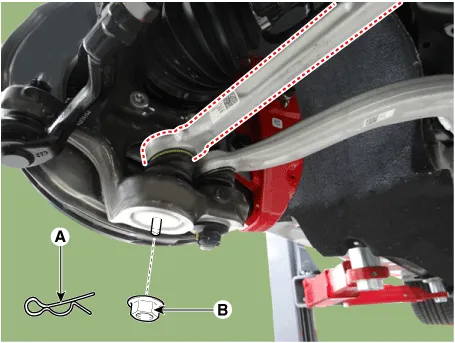
| 2. |
Loosen the lateral arm pin (A) and nut (B).
|
Tightening torque:
88.3 - 107.9 N·m (9.0 - 11.0 kgf·m, 65.1 - 79.6 lb·ft)
|
|
| 3. |
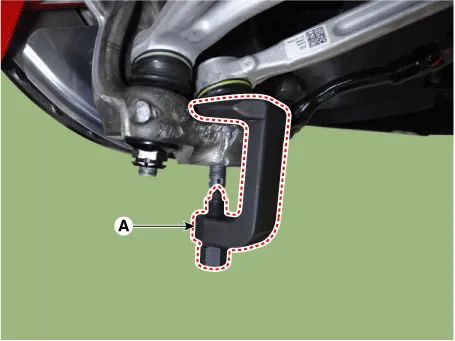
Remove the rateral arm by using the ball joint remover (A).
|
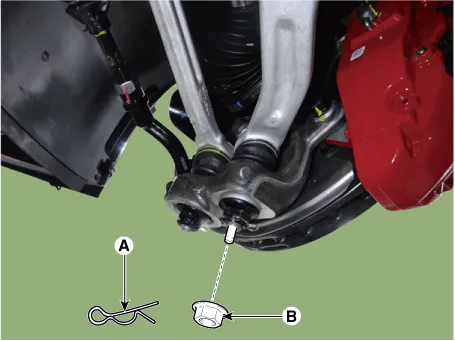
| 4. |
Loosen the compression arm pin (A) and nut (B).
|
Tightening torque :
88.3 - 107.9 N·m (9.0 - 11.0 kgf·m, 65.1 - 79.6 lb·ft)
|
|
| 5. |
Remove the compression arm by using the ball joint remover (A).

|
| 6. |
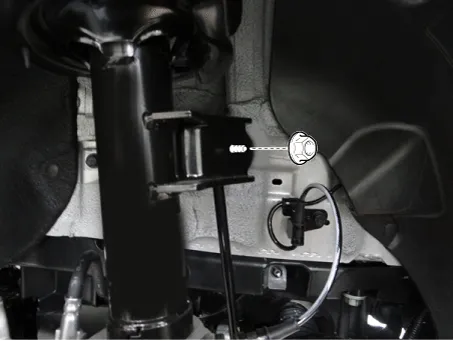
Loosen the nut and then separate the stabilizer link from the front shock
absorber.
|
Tightening torque :
98.1 - 117.7 N·m (10.0 - 12.0 kgf·m, 72.3 - 86.8 lb·ft)
|
|
| 7. |
By hammering on a chisel, unlock the driveshaft lock hub nut caulking.
|
If there is screw thread (A) on the end of the nut, unlock the
caulking by using a chisel and then loosen the nut to prevent damaging
driveshaft screw thread.
|
|
| 8. |
Loosen the caulking nut and then separate the hub assembly from the drive
shaft.
|
Tightening torque :
294.2 - 313.8 N·m (30.0 - 32.0 kgf·m, 217.0 - 231.5 lb·ft)
|
| •
|
Use plastic hammer to avoid damaging on axle when the
drive shaft is disassembled.
|
| •
|
Do not pull or twist excessively to remove the axle when
the drive shaft is disassembled.
|
|
|
The driveshaft lock nut must be replaced with new one.
When replacing the drive lock hub nut, use only the nut with
screw thread (A) on the end.
| •
|
Tighten the driveshaft lock hub nut to the specified
tightening torque, and caulk by using a chisel and hammer.
|
| •
|
If there are two key seats, perform on all two seats.
Caulking depth (A) : 1.5 mm (0.0591 in)
|
|
|
| 9. |
Remove the front drive shaft bracket (A). [LH]
|
Tightening torque :
49.0 - 63.7 N·m (5.0 - 6.5 kgf·m, 36.2.0 - 47.0 lb·ft)
|
[2.0 T-GDI
THETA II]
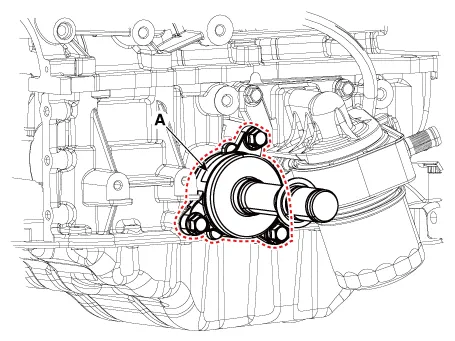
[R 2.2]
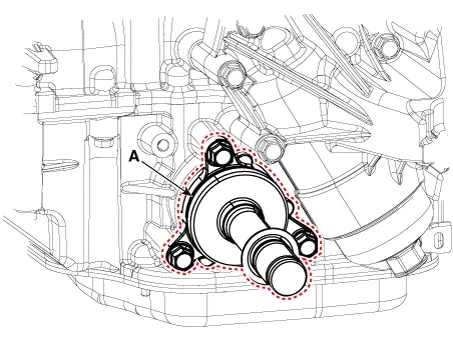
|
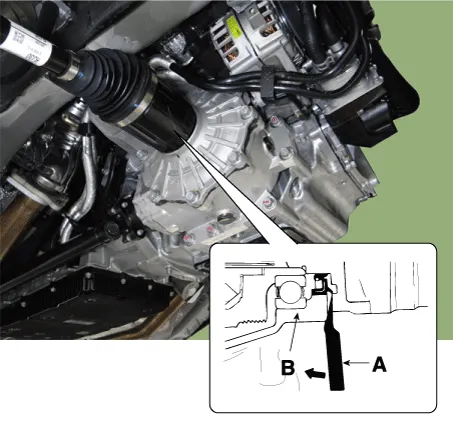
| 10. |
Using pry bar (A), separate the front drive shaft from the front differential
(B).
| •
|
Use a pry bar being careful not to damage the transaxle
and joint.
|
| •
|
Do not insert the pry bar too deep, as this may cause
damage to the oil seal.
|
| •
|
Do not pull the driveshaft by excessive force it may
cause components inside the joint kit to dislodge resulting
in a torn boot or a damaged bearing.
|
| •
|
Plug the hole of the transaxle case with the oil seal
cap to prevent contamination.
|
| •
|
Support the driveshaft properly.
- Be careful that the drive shaft is not bent or drop
down by other component's weight (such as axle etc.)
|
| •
|
Replace the retainer ring whenever the driveshaft is
removed from the transaxle case.
|
|
|
| 11. |
Install in the reverse order of removal.
|
Other information:
Kia Stinger (CK) 2018-2023 Service Manual: Front Door Window Glass
Components and components location
Component Location
1. Front door window glass
Repair procedures
Replacement
Put on gloves to protect your hands.
•
Use a plastic panel removal tool to remove interior trim pieces
without marring the surface.
Kia Stinger (CK) 2018-2023 Service Manual: Emergency Call (eCall) Unit
Components and components location
Component
The eCall unit for AVN is equipped in AVN head unit.
Repair procedures
Removal
Carry out the Test Mode after:
–
Replacing the eCall unit
–
Replacing the Back-up Battery (BUB)
–
Replacing the eCall speaker and MIC
–
Replacing the eCall antenna and roof antenna
•
Be careful not to scratch the cluster fascia panel and related
parts.