
Kia Stinger CK: Power Train / Spark Plug
Repair procedures
| Inspection |
| [On vehicle inspection] |
| 1. |
Accelerate the engine to about 3,000 rpm 3 times or more. |
| 2. |
Remove the spark plug. |
| 3. |
Check the spark plug visually. If the electrode is dry, the spark plug is normal. If the electrode is wet, check the damage and electrode gap as below. |
| [Component Inspection] |
| 1. |
Check the spark plug for any damage on its thread and insulator. If there is damage, replace the spark plug. |
| 2. |
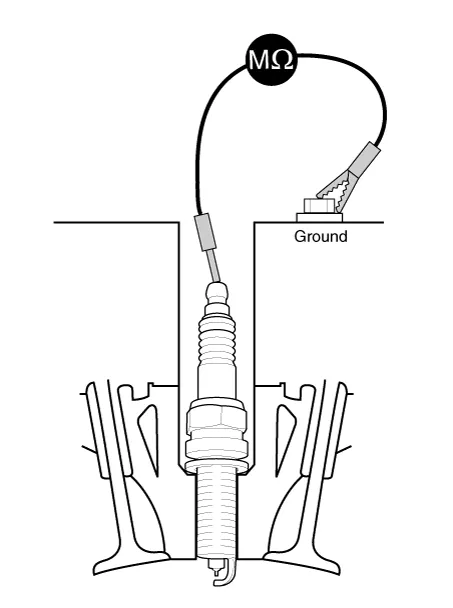
Check the electrode. Measure the insulation resistance with an ohmmeter. If the resistance is less than the specified value, adjust the electrode gap.
|
| 3. |
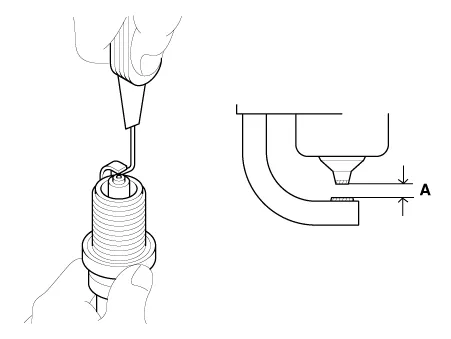
Check the spark plug electrode gap. If the gap is greater than the maximum, replace the spark plug.
|

| Removal |
| Theta-II 2.0 T-GDI |
| 1. |
Remove the ignition coil. (Refer to Ignition System - "Ignition Coil") |
| 2. |
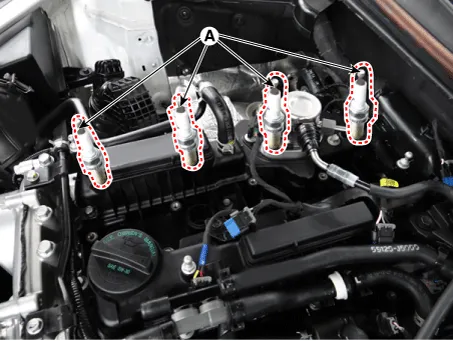
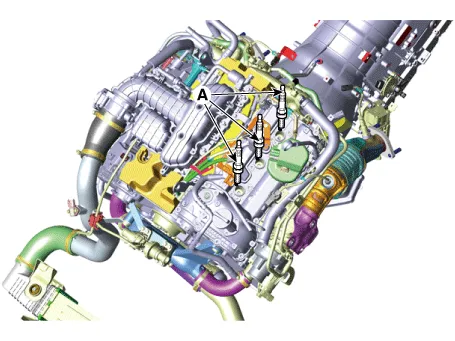
Using a spark plug wrench, remove the spark plug (A).
|
| Lambda-II 3.3 T-GDI |
| 1. |
Remove the ignition coil. (Refer to Engine Electrical System - "Ignition Coil") |
| 2. |
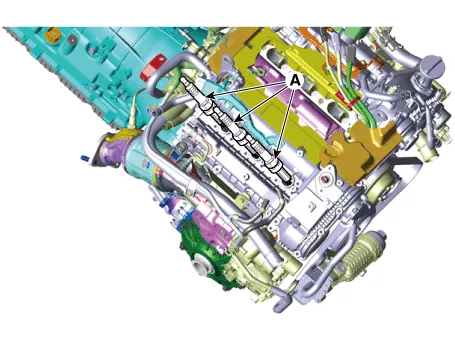
Using a spark plug wrench, remove the spark plug (A). [Bank 1]
[Bank 2]
|


Other information:
Kia Stinger (CK) 2018-2023 Service Manual: ISG (Idle Stop and Go) system
Your vehicle may be equipped with the ISG system, which reduces fuel consumption by automatically shutting down the engine, when the vehicle is at a standstill. (For example : red light, stop sign and traffic jam) The engine starts automatically as soon as the starting conditions are met. The ISG system is ON whenever the engine is running. ✽ NOTICE When the engine automatically starts by the ISG system, some warning lights (ABS, ESC, ESC OFF, EPS or Parking brake warning light) may turn on for a few seconds.Kia Stinger (CK) 2018-2023 Service Manual: When the lane ahead is clear
The vehicle speed will maintain the set speed. When there is a vehicle ahead of you in your lane The vehicle will maintain the set speed, when the lane ahead is clear. The vehicle will slow down or speed up within selected speed to maintain the selected distance, when there is a vehicle ahead of you in the lane. (A vehicle will appear in front of your vehicle in the LCD display only when there is an actual vehicle in front of you) If the vehicle ahead speeds up, your vehicle will travel at a steady cruising speed after accelerating to the selected speed.Categories
- Manuals Home
- Kia Stinger Owners Manual
- Kia Stinger Service Manual
- New on site
- Most important about car
