
Kia Stinger CK: Hydraulic System / ATF Warmer
Description and operation
| Description |
| • |
Engine coolant is used for circulating heat in order to heat and cool the transmission oil. |
| • |
Rapidly elevates the transmission oil temperature during the initial cold start of the engine. |
| • |
Prevents over heating of the transmission oil while the vehicle is moving. |
| • |
Transmission oil warm-up and cooling can be done with a single system. |
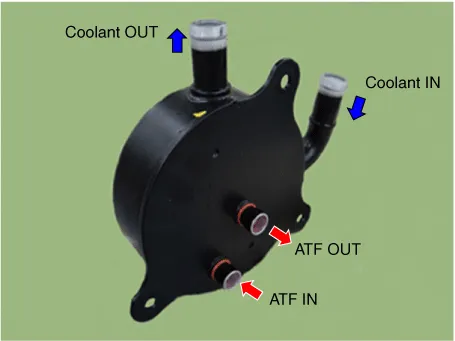
Components and components location
| Components Location |
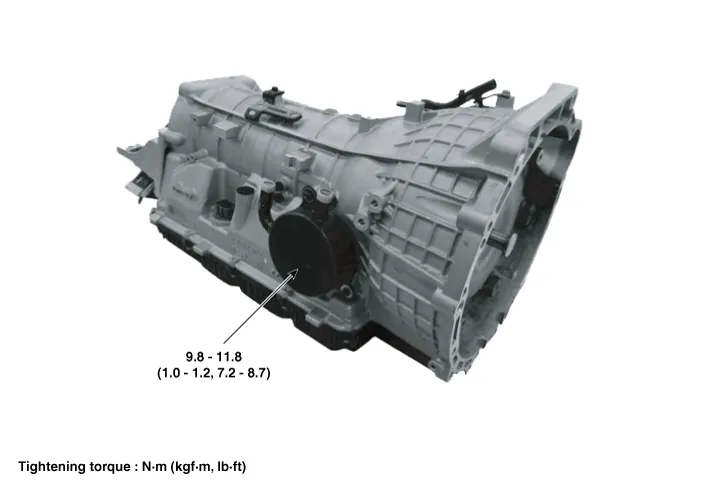
| 1. ATF warmer |
Repair procedures
| Removal |
| 1. |
Remove the under cover. (Refer to Engine Mechanical System - "Engine Room Under Cover"). |
| 2. |
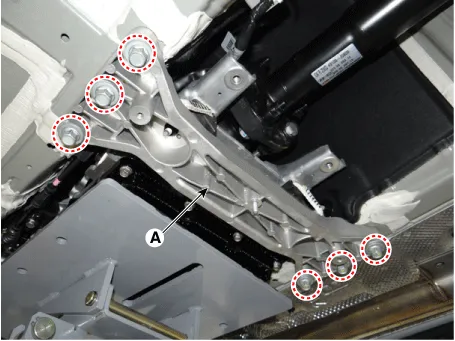
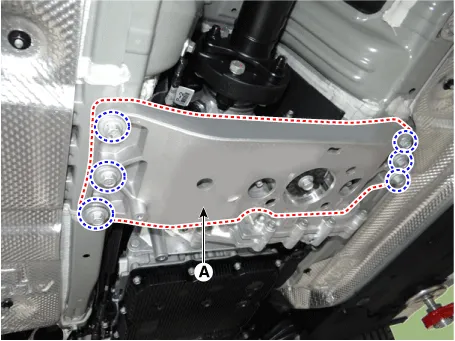
Support the transmission on a jack and then lower the jack slowly after loosening the cross member (A) mounting bolts. [2WD]
[4WD]
|
| 3. |
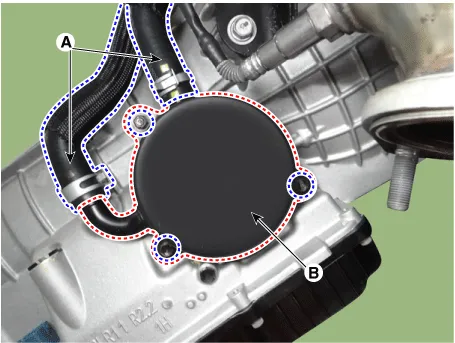
Separate the coolant hose (A) and remove the ATF warmer (B) after loosening the bolts.
|
| Installation |
| 1. |
Install in the reverse order of removal. |
| 2. |
Refill the automatic transmission with fluid. (Refer to Hydraulic System - "Fluid") |
| 3. |
Refill the engine coolant system radiator with coolant. (Refer to Engine Mechanical System - "Coolant") |


Other information:
Kia Stinger (CK) 2018-2023 Service Manual: Low Pressure Fuel Pump
Repair procedures Inspection [Fuel sender] 1. Switch "OFF" the ignition and disconnect the negative (-) battery terminal. 2. Remove the fuel pump assembly. 3. Using an ohmmeter, measure the resistance between terminals 1 and 2 of sender connector (A) at each float level.Kia Stinger (CK) 2018-2023 Service Manual: Low tire pressure telltale
When the tire pressure monitoring system warning indicators are illuminated, one or more of your tires is significantly under-inflated. If the telltale illuminates, immediately reduce your speed, avoid hard cornering and anticipate increased stopping distances. You should stop and check your tires as soon as possible. Inflate the tires to the proper pressure as indicated on the vehicle’s placard or tire inflation pressure label located on the driver’s side center pillar outer panel.Categories
- Manuals Home
- Kia Stinger Owners Manual
- Kia Stinger Service Manual
- New on site
- Most important about car
