Kia Stinger CK: Ignition System / Spark Plug
Specifications
Item
|
Specification
|
Type
|
SILZKR8H9G
|
Gap
|
0.8 - 0.9 mm (0.0314 - 0.0354 in.)
|
Electrode Material
|
Iridium
|
Description and operation
A spark plug is a device for delivering electric current from an ignition system
to the combustion chamber of a spark-ignition engine to ignite the compressed fuel/air
mixture therein by means of an electric spark, while containing combustion pressure
within the engine. A spark plug has a metal threaded shell, electrically isolated
from a central electrode by a porcelain insulator.

Repair procedures
| 1. |
Accelerate the engine to about 3,000 rpm 3 times or more.
|
| 2. |
Remove the spark plug.
|
| 3. |
Check the spark plug visually.
If the electrode is dry, the spark plug is normal.
If the electrode is wet, check the damage and electrode gap as below.
|
| 1. |
Check the spark plug for any damage on its thread and insulator.
If there is damage, replace the spark plug.
|
| 2. |
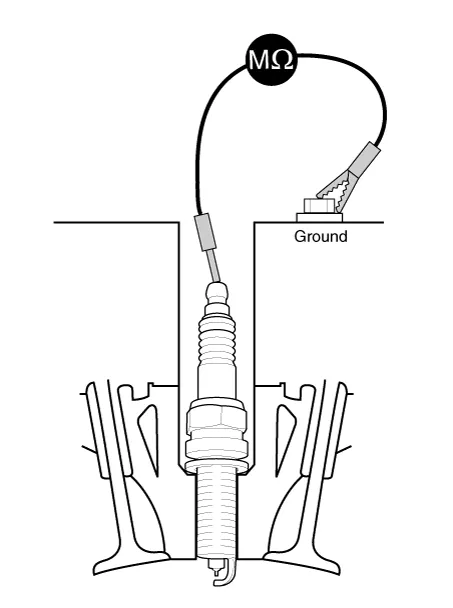
Check the electrode. Measure the insulation resistance with an ohmmeter.
If the resistance is less than the specified value, adjust the electrode
gap.
|
Specification: 10 MΩ or more
|
|
| 3. |
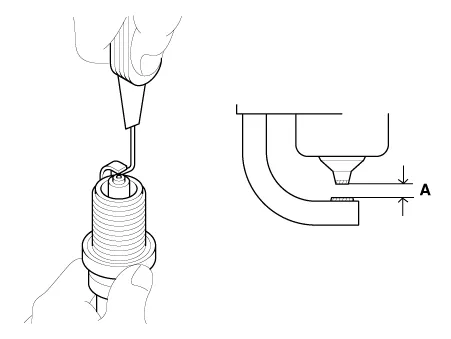
Check the spark plug electrode gap.
If the gap is greater than the maximum, replace the spark plug.
|
Specification: 0.8 - 0.9 mm (0.0314 - 0.0354 in.)
|
| •
|
If adjusting the gap of a new spark plug, bend only the
base of the ground electrode. Do not touch the tip.
Never attempt to adjust the gap on a used plug.
|
|
|
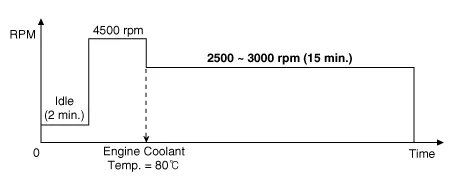
The combustion temporarily becomes unstable, due to the aged fuel and the carbon
deposits accumulated on the spark plug(s) after long-term storage.
| 1. |
Start the engine and keep the engine running at idle for 2 minutes.
|
| 2. |
Step on the accelerator pedal and hold it steady at 4500 rpm with the
shift lever in N position to warm up the engine until the temperature
of the engine coolant reaches 80°C.
|
| 3. |
Keep the engine running at 2500 - 3000 rpm in the N position for 15 minutes.
|
| • |
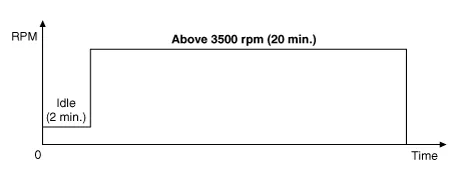
The 2nd method should be performed only if the 1st method fails
(the misfire-related codes recur).
|
|
| 1. |
Start the engine and keep the engine running at idle for 2 minutes.
|
| 2. |
Drive the vehicle for over 20 minutes, keeping the engine speed above
3500 rpm.
| •
|
If equipped with manual transaxle, shift the gear properly
for keeping the engine speed above 3500 rpm.
|
|
|
| 1. |
Remove the ignition coil.
(Refer to Ignition System - "Ignition Coil")
|
| 2. |
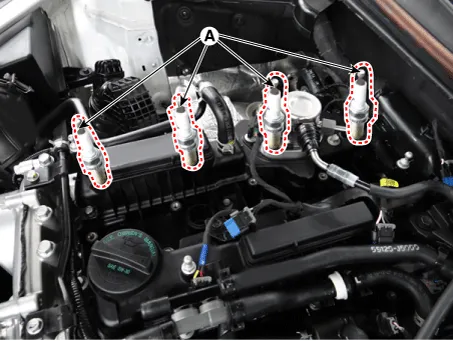
Using a spark plug wrench, remove the spark plug (A).
|
| 1. |
Install in the reverse order of removal.
|
Tightening torque:
14.7 - 24.5 N·m (1.5 - 2.5 kgf·m, 10.9 - 18.0 Ib·ft)
|
|