
Kia Stinger CK: Hydraulic System / Oil Cooler
Components and components location
| Components |

| 1. Oil cooler tube 2. Oil cooler pipe |
3. Oil cooler valve 4. Oil cooler |
Repair procedures
| Replacement |
Oil cooler
| 1. |
Remove the front bumper. (Refer to Body - "Front Bumper Aseembly") |
| 2. |
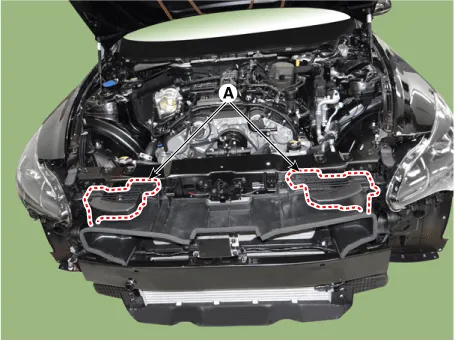
Remove the air intake shield (A).
|
| 3. |
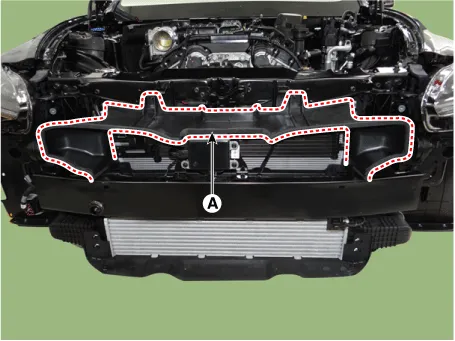
Remove the air guard (A) by loosening the bolts after separating the wiring fixing clip.
|
| 4. |
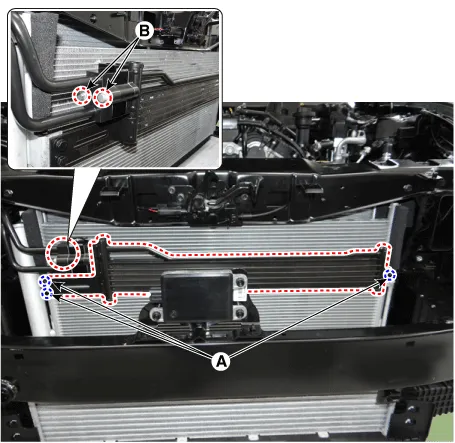
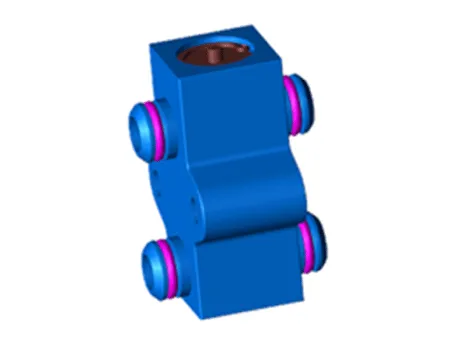
Remove the oil cooler after loosening the bolts (A, B)
|

| 5. |
Install in the reverse order of removal. |
| 6. |
Refill the automatic transmission with fluid. (Refer to Hydraulic System - "Fluid") |
Oil cooler valve
| 1. |
Remove the front bumper. (Refer to Body - "Front Bumper Aseembly") |
| 2. |
Remove the air intake shield (A).
|
| 3. |
Remove the air guard (A) by loosening the bolts after separating the wiring fixing clip.
|
| 4. |
Separat the oil cooler tube (A)and loosen the bolt (B).
|
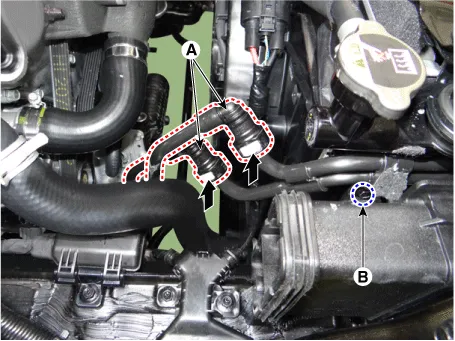
| 5. |
Remove the oil cooler valve (B) after loosening the bolts (A).
|
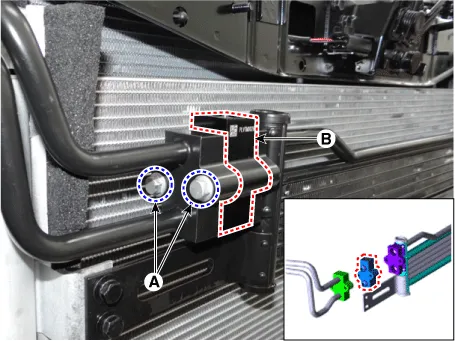
| 6. |
Install in the reverse order of removal. |
| 7. |
Refill the automatic transmission with fluid. (Refer to Hydraulic System - "Fluid") |
Oil cooler pipe
| 1. |
Remove the front bumper. (Refer to Body - "Front Bumper Aseembly") |
| 2. |
Remove the air intake shield (A).
|
| 3. |
Remove the air guard (A) by loosening the bolts after separating the wiring fixing clip.
|
| 4. |
Separat the oil cooler tube (A)and loosen the bolt (B).
|
| 5. |
Loosen the condenser mounting bolt (A).
|
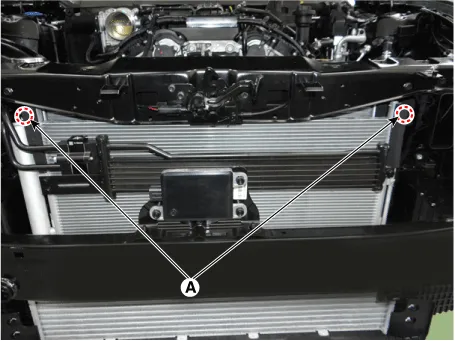
| 6. |
Remove the oil cooler pipe (A) after loosening the bolts.
|
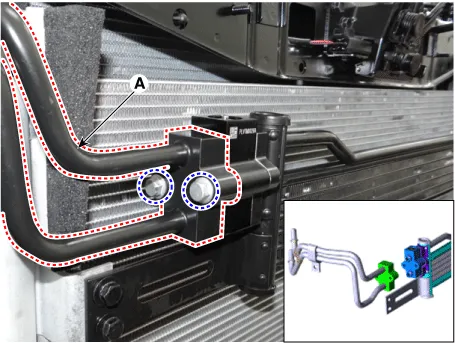
| 7. |
Install in the reverse order of removal. |
| 8. |
Refill the automatic transmission with fluid. (Refer to Hydraulic System - "Fluid") |
Oil cooler tube
| 1. |
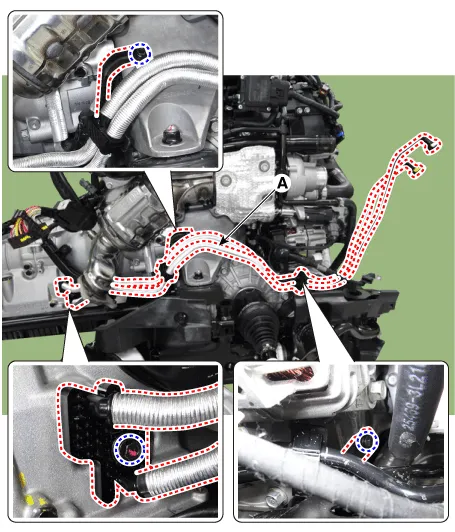
Remove the sub frame. (Refer to Suspension System - "Sub Frame") |
| 2. |
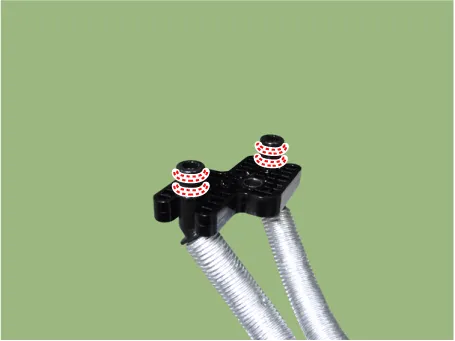
Removethe oil cooler tube (A).
|
| 3. |
Install in the reverse order of removal. |
| 4. |
Refill the automatic transmission with fluid. (Refer to Hydraulic System - "Fluid") |


Other information:
Kia Stinger (CK) 2018-2023 Service Manual: Outside rearview mirror
Be sure to adjust the mirror angles before driving. Your vehicle is equipped with both left-hand and right-hand outside rearview mirrors. The mirrors can be adjusted remotely with the remote switch. The mirror heads can be folded back to prevent damage during an automatic vehicle wash or when passing through a narrow street. The right outside rearview mirror is convex.Kia Stinger (CK) 2018-2023 Service Manual: SRS Control Module (SRSCM)
Description and operation Description The primary purpose of the SRSCM (Supplemental Restraints System Control Module) is to discriminate between an event that warrants restraint system deployment and an event that does not. The SRSCM must decide whether to deploy the restraint system or not. After determining that pretensioners and/or airbag deployment is required, the SRSCM must supply sufficient power to the pretensioners and airbag igniters to initiate deployment.Categories
- Manuals Home
- Kia Stinger Owners Manual
- Kia Stinger Service Manual
- New on site
- Most important about car
