
Kia Stinger CK: Brake System / Brake System
Kia Stinger (CK) 2018-2023 Service Manual / Brake System / Brake System
Contents:
- Brake Booster
- Vacuum Pump
- Master Cylinder
- Brake Line
- Brake Pedal
- Front Disc Brake
- Rear Disc Brake
- Stop Lamp Switch
Repair procedures
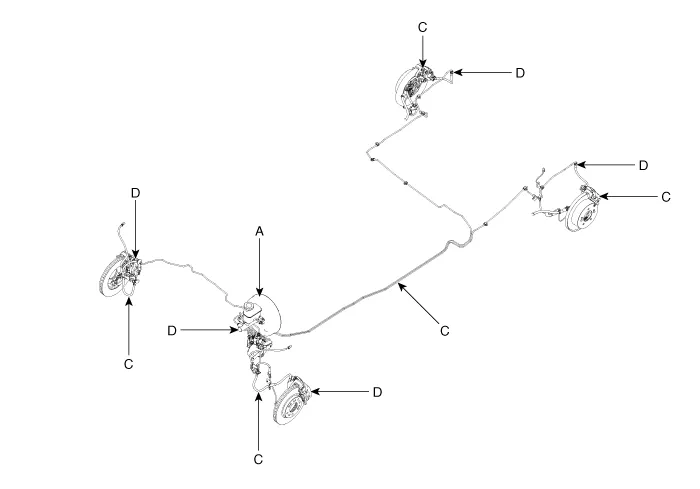
| Operation and Leakage Check |
Check all of the following items:
|
Component |
Procedure |
|
|
Brake Booster (A) |
Check brake operation by applying the brakes during a test drive. If the
brakes do not work properly, check the brake booster. Replace the brake
booster as an assembly if it does not work properly or if there are signs
of leakage. |
|
|
Piston cup and pressure cup inspection (B) |
• Check brake operation by applying the brakes. Look for damage or signs
of fluid leakage. Replace the master cylinder as an assembly if the pedal
does not work properly or if there is damage or signs of fluid leakage.
• Check for a difference in brake pedal stroke between quick and slow brake applications. Replace the master cylinder if there is a difference in pedal stroke. |
|
|
Brake hoses (C) |
Look for damage or signs of fluid leakage. Replace the brake hose with a
new one if it is damaged or leaking. |
|
|
Caliper piston seal and piston boots (D) |
Check brake operation by applying the brakes. Look for damage or signs of fluid leakage. If the pedal does not work properly, the brakes drag, or there is damage or signs of fluid leakage, disassemble and inspect the brake caliper. Replace the boots and seals with new ones whenever the brake caliper is disassembled. |
|
Brake Booster ➤
Vacuum Pump ➤
Master Cylinder ➤
Brake Line ➤
Brake Pedal ➤
Front Disc Brake ➤
Rear Disc Brake ➤
Stop Lamp Switch ➤


Other information:
Kia Stinger (CK) 2018-2023 Service Manual: How does the air bag system operate?
Air bags are activated (able to inflate if necessary) only when the Engine Start/Stop button is turned to the ON or engine is running. The appropriate air bags inflate instantly in the event of a serious frontal collision or side collision in order to help protect the occupants from serious physical injury. There is no single speed at which the air bags will inflate.Kia Stinger (CK) 2018-2023 Service Manual: Rear Axle Assembly
Components and components location Components 1. Rear brake disc 2. Hub assembly 3. Dust cover 4. Rear knuckle Repair procedures Removal 1. Remove wheel nuts, rear wheel and tire (A) from rear hub. Tightening torque : 107.9 - 127.5 N·m (11.Categories
- Manuals Home
- Kia Stinger Owners Manual
- Kia Stinger Service Manual
- Brake Booster
- Vacuum Pump
- Master Cylinder
- Brake Line
- Brake Pedal
- Front Disc Brake
- Rear Disc Brake
- Stop Lamp Switch
- New on site
- Most important about car
Contents

Copyright © 2026 www.kstinger.com 0.0134