
Kia Stinger CK: Body (Interior and Exterior) / Crash Pad
Contents:
- Cluster Fascia Panel
- Center Fascia Panel
- Crash Pad Lower Panel
- Steering Column Shroud Panel
- Glove Box Housing
- Crash Pad Center Panel
- Main Crash Pad Assembly
- Cowl Cross Bar Assembly
Components and components location
| Components |
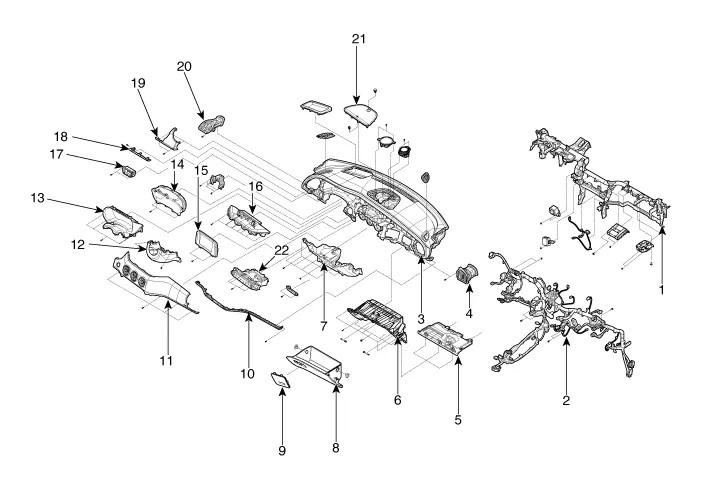
| 1. Cowl cross member bar 2. Main wiring 3. Main crash pad 4. Side air vent duct [RH] 5. Crash pad under cover [RH] 6. Crash pad lower panel [RH] 7. Crash pad center lower cover 8. Glove box housing 9. Fuse A/S cover 10. Crash pad garnish [RH] 11. Crash pad passenger side panel |
12. Steering column lower shroud
13. Cluster fascia upper panel 14. Cluster assembly 15. A.V.N monitor 16. monitor fascia panel 17. Crash pad side switch 18. Crash pad garnish [LH] 19. Crash pad driver side panel 20. Side air vent duct [LH] 21. Center speaker grille |
Cluster Fascia Panel ➤
Center Fascia Panel ➤
Crash Pad Lower Panel ➤
Steering Column Shroud Panel ➤
Glove Box Housing ➤
Crash Pad Center Panel ➤
Main Crash Pad Assembly ➤
Cowl Cross Bar Assembly ➤


Other information:
Kia Stinger (CK) 2018-2023 Service Manual: Electric power steering (EPS)
The power steering uses a motor to assist you in steering the vehicle. If the engine is off or if the power steering system becomes inoperative, the vehicle may still be steered, but it will require increased steering effort. The EPS is controlled by a power steering control unit which senses the steering wheel torque and vehicle speed to command the motor.Description and operation Description Electric E-CVVT system is electric continuous variable valve timing system. It is located on the intake camshaft of the engine and uses motor rotation to control the rotation angle of camshaft relative to the rotation of crankshaft regardless of engine pressure. E-CVVT controls the DC motor current (duty signal) to more closely control the system compared to the previous pressure type, to increase reaction speed of cam, to improve startability, and to reduce the emission of exhaust gas.Categories
- Manuals Home
- Kia Stinger Owners Manual
- Kia Stinger Service Manual
- Cluster Fascia Panel
- Center Fascia Panel
- Crash Pad Lower Panel
- Steering Column Shroud Panel
- Glove Box Housing
- Crash Pad Center Panel
- Main Crash Pad Assembly
- Cowl Cross Bar Assembly
- New on site
- Most important about car
Contents

Copyright © 2026 www.kstinger.com 0.0109